Putin tried to move a vital Russian export lifeline out of Ukraine’s reach — but Ukraine’s drones followed the escape route.
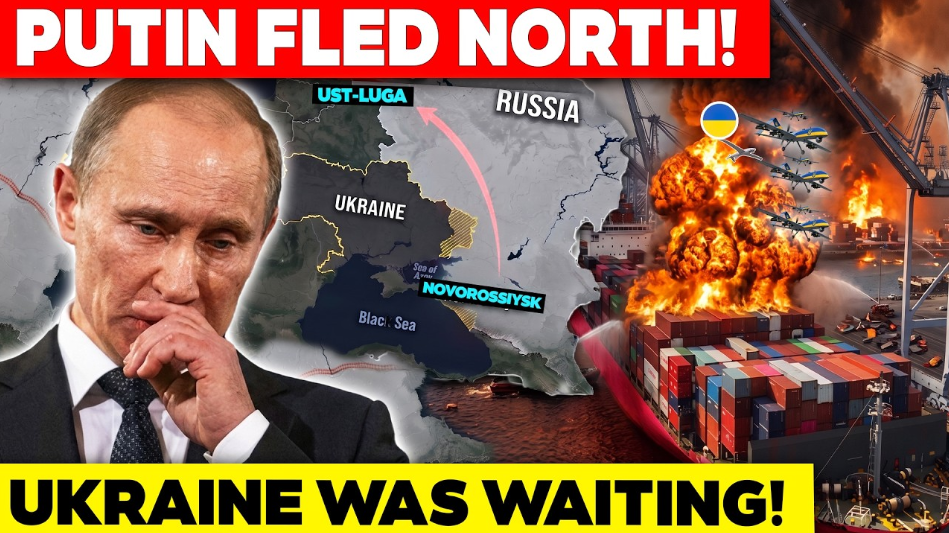
As Ukrainian drone attacks increasingly disrupt Russia’s Black Sea and Sea of Azov trade network, Putin’s Russia is being forced to reroute critical grain exports north toward the Baltic Sea. But there is a massive problem: one of the key ports Moscow is relying on, Ust-Luga, is already within range of Ukrainian long-range drones.
Russia moved the route. Ukraine reached it anyway.
In this Power Faultlines investigation, we break down how Ukraine’s drone campaign is putting pressure on Putin’s wartime economy, why Russian grain exporters are shifting traffic away from Novorossiysk and the Black Sea, and what happened when Ukrainian drones struck the Ust-Luga port complex near St. Petersburg just as Russia was increasingly looking north for an alternative export route.
The scale of the problem is enormous. Russia moved 46.3 million tonnes of grain through its Black Sea and Azov ports last season — roughly 90% of its seaborne grain exports — while its Russian Baltic ports handled only around one million tonnes. Moscow is now attempting to redirect part of that enormous trade toward a network with far less capacity. Black Sea escape .pdf
And Ust-Luga is much more than a grain route. It is a strategically important Russian Baltic export hub tied to oil, petroleum products and other commodities, making repeated Ukrainian strikes there an even bigger challenge for Putin and the Kremlin. Recent reporting confirms Ukrainian drones struck the Ust-Luga complex again on September 1.
This raises a much bigger question for Vladimir Putin and Russia: if Moscow can no longer rely on distance to protect its ports, refineries and export infrastructure, where does Russia move its most important economic lifelines next?
The grain moved. The threat followed it.
Subscribe to Power Faultlines for deeply researched analysis of Putin, Russia, Ukraine, the Russia-Ukraine war, Ukrainian drone warfare, Russian military strategy, geopolitics, energy infrastructure and the economic pressure shaping the war.
DISCLAIMER: Power Faultlines is an independent geopolitical analysis and news commentary channel. Our videos are produced for informational, educational and documentary purposes using publicly available reporting and open-source information. Power Faultlines does not endorse or glorify violence, military action, governments or any party to the conflict. Information surrounding an active war can change rapidly, and battlefield claims may be disputed, incomplete or subsequently revised.