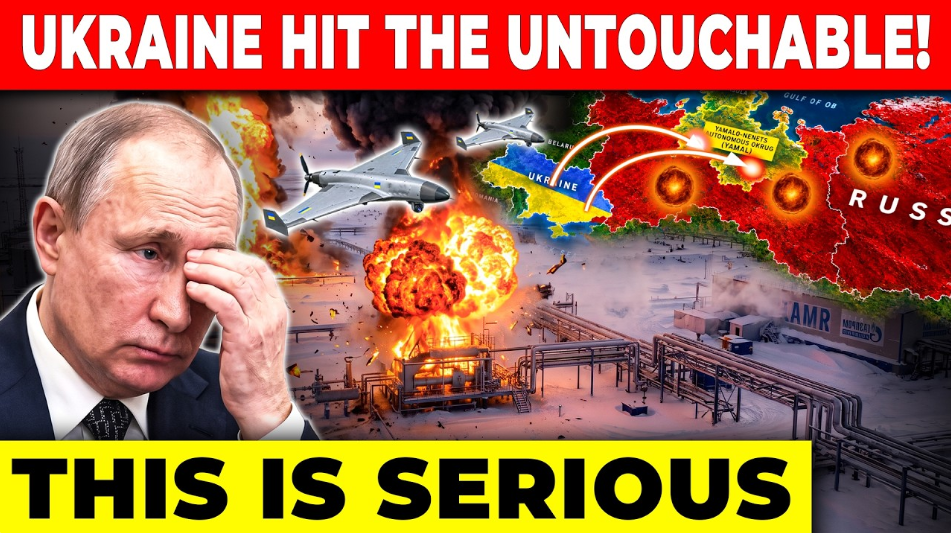
Ukraine has carried out one of the deepest drone strikes of the Russia-Ukraine war, reaching Russia’s Arctic gas heartland thousands of kilometers from the Ukrainian border. The operation targeted major gas-condensate facilities at Novy Urengoy and Purovsky in the Yamalo-Nenets region — an area long considered part of Russia’s protected strategic rear.
In this video, we break down why the strike matters far beyond the explosion itself. Yamalo-Nenets sits at the center of Russia’s enormous natural-gas industry, making the region strategically important to Moscow’s energy economy. We examine how Ukrainian long-range drones reportedly travelled more than 3,000 kilometers into Russian territory, what this means for Vladimir Putin’s ability to protect critical infrastructure across Russia’s vast geography, and why the concept of a “safe rear” may be disappearing.
We also look at Ukraine’s rapidly expanding domestic weapons industry, including Fire Point and its FP-1 long-range strike drone, the growing reach of Ukraine’s deep-strike campaign, and another important development: Ukraine’s domestically developed Vyrivniuvach — or “Equalizer” — guided glide bomb.
From Russian gas infrastructure in the Arctic to Ukrainian-made drones and precision weapons at the front, this is ultimately a story about one increasingly important factor in the war: distance.
Russia once relied on geography as a layer of defense.
Ukraine is increasingly finding ways around it.