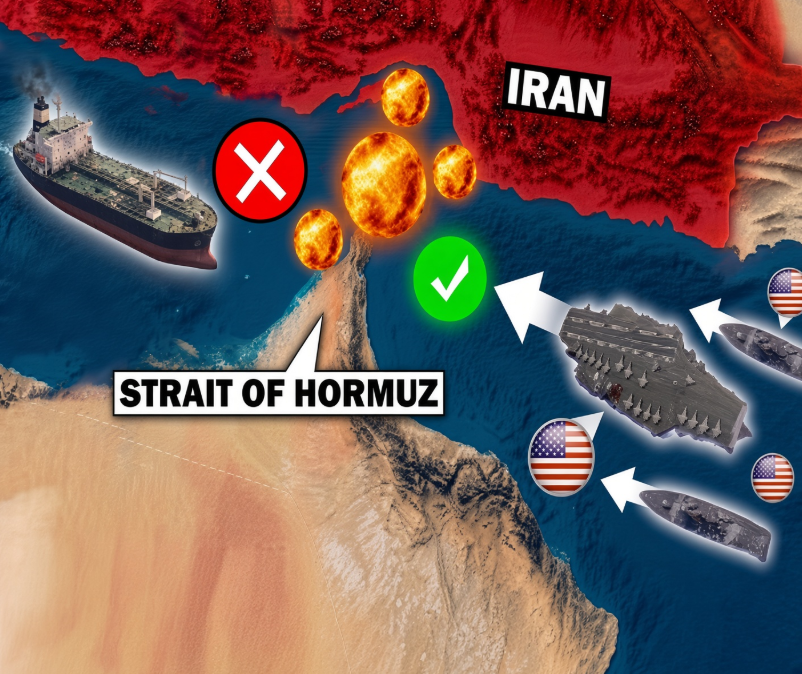
Tensions between the United States and Iran over the Strait of Hormuz have intensified amid allegations of attacks on commercial shipping and a growing American military response. The report portrays Washington’s actions as an effort to challenge Iran’s restrictions on maritime traffic and protect international shipping through a corridor vital to global energy supplies.
A central claim concerns the USS Spruance and its reported engagement with the M/V Touska, alongside U.S. Marines conducting boarding operations. The account also references the Sanmar Herald as a commercial vessel allegedly targeted during the confrontation. However, the precise circumstances of these incidents, including the vessels’ status, the extent of any damage and the legal basis for the reported operations, require independent verification.
The report describes a broader American military buildup involving the aircraft carriers USS Gerald R. Ford and USS Abraham Lincoln, B-52 bombers and F-35A stealth aircraft. Such deployments, if confirmed in the described configuration, would indicate a substantial effort to reinforce U.S. military capabilities in the region. The account also alleges that AI-enabled drones are helping monitor vessels through acoustic and thermal data, while specialized American forces pursue ships linked to Iran.
The confrontation carries consequences beyond the immediate military standoff. The Strait of Hormuz is a critical route for global oil and gas shipments, meaning prolonged disruption could increase energy prices, raise insurance costs for commercial vessels and create uncertainty in international markets. Any direct exchange between U.S. and Iranian forces could also widen the conflict and increase risks to civilian crews.
The report further references an ultimatum from President Donald Trump and an alleged strategic military landing in Islamabad, presenting these developments as part of a wider campaign to pressure Tehran economically and militarily. The details and significance of these claims remain unclear and should be verified through reliable reporting and official statements.
Overall, the account describes an increasingly confrontational U.S. approach to maritime security, combining naval deployments, vessel inspections and surveillance capabilities. However, its strongest claims—including a comprehensive naval lockdown, AI-directed global ship seizures and the complete defeat of Iran’s blockade—should not be treated as established facts without independent confirmation. The situation’s impact will depend on verified military developments, the safety of commercial shipping and whether diplomatic channels can prevent further escalation.