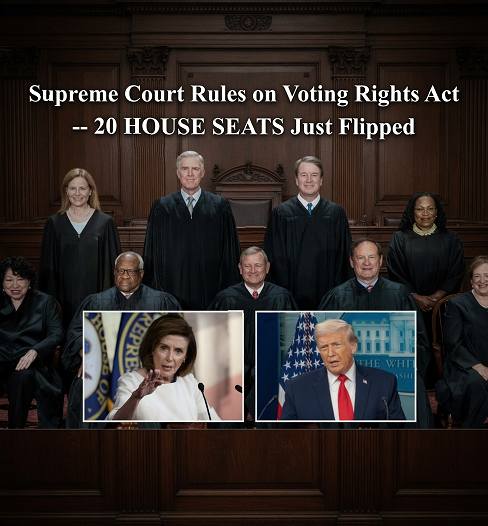
The article describes a major Supreme Court ruling involving Louisiana’s congressional redistricting map and its use of race in drawing electoral districts, with potential national implications for future House elections and the Voting Rights Act.
According to the report, the Court struck down Louisiana’s revised congressional map, which had been drawn after lower courts ordered the creation of a second majority-Black district. That earlier order was based on Section 2 of the Voting Rights Act of 1965, which prohibits election systems that dilute the voting strength of racial or language minorities. Louisiana’s population is roughly one-third Black, and the state’s congressional delegation includes two Democratic representatives elected from majority-Black districts.
State officials and the Trump administration challenged the revised map, arguing that it amounted to unconstitutional racial gerrymandering under the Equal Protection Clause of the 14th Amendment. They claimed that using race as a primary factor in drawing districts violates constitutional principles, even when done to comply with the Voting Rights Act.
During oral arguments, Justice Department officials argued that the map effectively gave preferential treatment based on race, suggesting that similar districts would not have been created for white voters. The Court’s ruling is described as significantly limiting how race can be used in redistricting going forward.
The decision is widely interpreted as potentially narrowing the scope of Section 2 of the Voting Rights Act, which has long been used to challenge discriminatory district maps. Voting rights advocates warned that restricting or weakening Section 2 could allow state legislatures—particularly in Republican-controlled states—to redraw districts in ways that could favor their party, potentially affecting as many as 19 congressional districts.
The article notes that the ruling could accelerate a wave of redistricting efforts ahead of upcoming elections, including the 2026 midterms. However, it also acknowledges uncertainty about timing, suggesting that legal and procedural constraints may limit immediate nationwide changes before the next election cycle.
Chief Justice John Roberts is portrayed as focusing on consistency with prior precedent, including earlier rulings requiring states to meet specific criteria before considering race in district design. Justice Brett Kavanaugh is described as open to the idea that race-based remedies should be temporary rather than permanent.
Voting rights organizations cited in the report argue that restricting Section 2 could have long-term political consequences, potentially making it harder for Democrats to compete in certain districts and increasing Republican advantages in closely divided states.
Overall, the article frames the ruling as a significant shift in how race can be considered in electoral mapmaking, with wide-ranging implications for congressional representation and future political control of the House of Representatives.