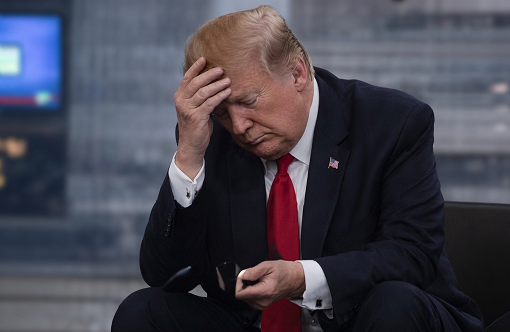
Donald Trump’s quiet appearance in Washington, D.C. marked a rare and revealing moment in the long public arc of his political life. Unlike the rallies, headlines, and confrontational speeches that have defined his career, this moment unfolded in near silence. The nation’s capital, usually filled with motion and political spectacle, seemed unusually still. Observers noted that Trump’s demeanor appeared different—not defeated, but subdued, carrying a visible sense of weight and reflection that contrasted sharply with his usual image of unwavering confidence and momentum.
For years, Trump cultivated a public persona rooted in dominance, certainty, and constant forward motion. Through controversies, legal battles, electoral defeat, and relentless media attention, he consistently projected strength and defiance. Yet during this brief period in Washington, the familiar performance of political combativeness seemed absent. Instead, Trump appeared as a figure confronting the reality that his presidency and actions were no longer unfolding in real time but were entering the phase of historical judgment and accountability.
Commentators emphasized that this was not a display of weakness, but rather a quieter acknowledgment of consequence. Decisions once framed as disruptive or bold had now become part of the permanent public record. Legal scrutiny, political evaluations, and historical interpretation were no longer distant possibilities—they had become immediate realities. In that sense, the moment symbolized the narrowing gap between holding power and answering for its impact.
The stillness surrounding Trump also highlighted a broader truth about leadership: power is temporary, but its consequences endure. The machinery of government continued without the urgency that once accompanied his presidency, underscoring how political influence eventually gives way to institutional continuity and public reflection. Trump’s presidency undeniably reshaped American politics, civic discourse, and institutional norms, ensuring that his legacy will remain a subject of debate and analysis for decades.
The essay argues that history is often shaped not only by dramatic speeches or elections, but by quieter moments of transition when spectacle fades and interpretation begins. Trump’s pause in Washington became symbolic of this process—a human interval stripped of slogans and performance. Supporters and critics alike projected meaning onto the silence, but the deeper significance lay in the universal reality that no leader leaves power unchanged.
Ultimately, the piece suggests that Trump’s defining legacy may depend less on any single court ruling or political event and more on the prolonged reckoning that follows his time in office. As Washington resumed its normal rhythm, the moment passed without ceremony, yet it carried the feeling of a threshold being crossed. In that quiet transition, history itself seemed to slow down long enough to take notice.