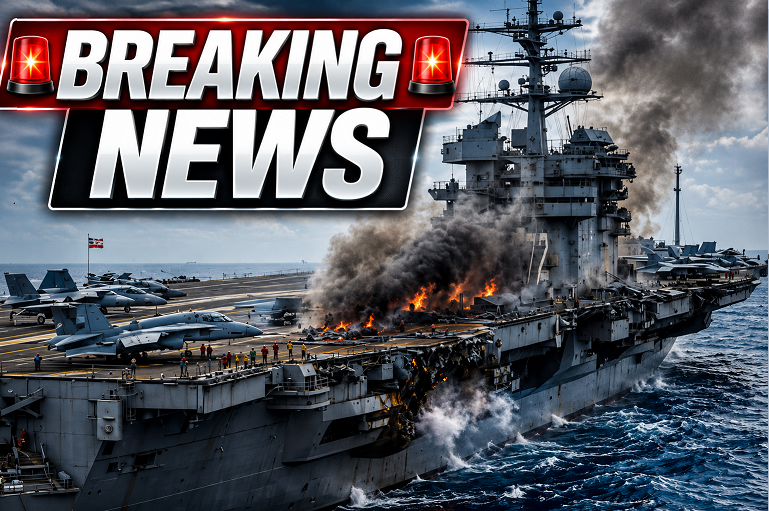
Developing and highly contested geopolitical situation in the Arabian Sea involving conflicting reports of a potential missile strike against a U.S. Navy aircraft carrier, the USS Abraham Lincoln (CVN-72). The narrative centers on competing claims between Iranian state-affiliated media and U.S. defense authorities, with each side presenting sharply different accounts of events and their significance.
According to Iranian-linked reports, missile forces allegedly launched a retaliatory strike targeting a U.S. naval vessel operating in or near the northern Arabian Sea. These claims suggest that ballistic missiles were fired in response to perceived hostile actions by U.S. and allied forces in the region. Some versions of the narrative go further, implying that missiles either reached the carrier group or forced it to take evasive action. Iranian messaging frames the operation as both a defensive response and a demonstration of military capability, emphasizing deterrence and strategic signaling rather than outright escalation.
However, the passage stresses that none of these claims have been independently verified. No third-party military confirmation, satellite imagery, or neutral assessment has validated reports of damage or impact on U.S. naval assets. Instead, U.S. Central Command (CENTCOM) and other defense officials firmly deny that any strike occurred. American statements assert that the USS Abraham Lincoln and its accompanying strike group remain fully operational, with no disruption to missions or flight operations. U.S. sources further argue that any hostile missile activity in the area was either intercepted, failed mid-flight, or posed no real threat.
The text highlights the strategic importance of aircraft carriers in modern military power projection. The USS Abraham Lincoln is described as a central element of U.S. naval capability, capable of sustained air operations far from home waters. A carrier strike group includes multiple escort vessels such as destroyers, cruisers, submarines, and logistics ships, forming a highly protected and mobile military platform. Because of their symbolic and operational significance, aircraft carriers are often viewed as high-value targets, meaning even unverified claims about them can generate substantial global attention and political sensitivity.
The passage then places the incident within a broader context of regional instability and military escalation. It describes ongoing tensions involving maritime security, strategic chokepoints such as the Strait of Hormuz, and broader U.S.–Iranian rivalry. The potential for disruption in these waters is noted as a major concern for global energy markets, since a significant portion of the world’s oil supply passes through the region. Even rumors of conflict or naval engagement are said to create volatility in oil prices and financial markets due to fears of supply disruption.
A major theme in the text is information warfare and competing narratives. Iranian media outlets are portrayed as emphasizing claims of successful retaliation or symbolic military achievement, while U.S. sources focus on denial, operational continuity, and accusations of misinformation. The passage suggests that in modern conflicts, control of information and perception can be as strategically important as physical military outcomes, especially when direct verification is limited.
Diplomatic responses are also referenced, with international actors reportedly urging restraint and emphasizing the importance of verifying claims before drawing conclusions. The passage notes that multiple governments are concerned about miscalculation or accidental escalation, particularly in a densely trafficked maritime region where civilian and military activity coexist.
In addition, the text describes increased military readiness in the region, including heightened surveillance and monitoring by naval forces. These measures are presented as precautionary rather than indicative of confirmed conflict, reflecting standard procedures during periods of elevated tension.
Finally, the passage concludes that the situation remains unresolved and fluid. There is no confirmed evidence of a strike or damage, and the competing narratives continue to shape diplomatic discussions, market behavior, and strategic calculations. The broader uncertainty underscores the fragility of the regional security environment and the role of perception, communication, and misinformation in shaping modern geopolitical crises.