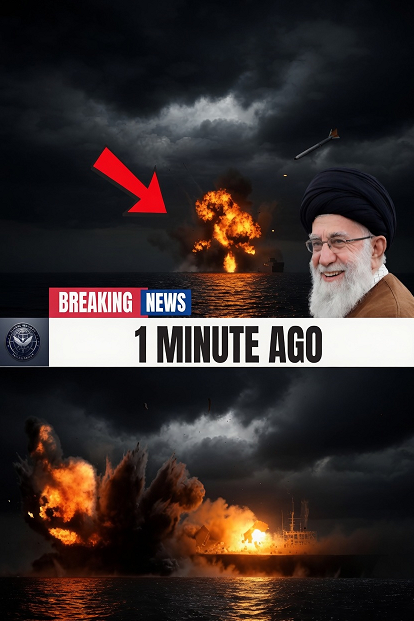
Sudden escalation of a naval confrontation in the Strait of Hormuz, where a previously controlled and predictable pattern of military signaling collapses into active combat.
It begins by framing the Strait as a highly tense but generally stable environment, where Iranian and U.S. naval forces had long engaged in routine but risky interactions—shadowing, warnings, and probing maneuvers that functioned as a form of tacitly understood deterrence. This fragile balance is disrupted when Iranian forces launch a missile attack from concealed coastal positions against a U.S. carrier strike group led by the USS Theodore Roosevelt.
The attack is rapid and coordinated, with multiple anti-ship missiles detected almost immediately by U.S. radar systems. The crew responds according to established combat protocols, transitioning from detection to engagement within seconds. The carrier strike group’s layered defense system activates in sequence: Aegis-equipped destroyers launch SM-2 interceptor missiles, close-in weapon systems engage at short range, and electronic warfare units deploy jamming and decoy measures to disrupt incoming missile guidance. The narrative emphasizes the integration and discipline of the defensive network, highlighting how automation, training, and coordination work together under pressure.
Despite the intensity of the assault, the defense proves effective. Several incoming missiles are intercepted mid-flight, while others are diverted or destroyed by close-range systems. Debris falls into the sea without striking the carrier group, and not a single missile reaches its intended target. The passage underscores the speed and efficiency of modern naval air defense, portraying the engagement as a high-tech, multi-layered contest of detection and interception rather than chaotic combat.
After the initial attack is fully neutralized, the narrative shifts to a rapid counteroffensive. U.S. forces respond with coordinated strikes launched from outside immediate retaliation range. Tomahawk cruise missiles are fired toward Iranian coastal missile batteries, while carrier-based aircraft launch precision-guided munitions against radar installations, launch sites, and command infrastructure identified during the attack.
These retaliatory strikes are depicted as swift and systematic, overwhelming Iranian coastal defenses. Launch sites are destroyed, radar systems are disabled, and command structures are disrupted in quick succession. The Iranian forces are shown struggling to maintain coordination as their communications degrade and their defensive positions are reduced to ruins.
The entire engagement unfolds over roughly half an hour, beginning with the initial missile launch and ending with the destruction of the attacking infrastructure. The passage emphasizes the speed of escalation, the effectiveness of layered missile defense systems, and the overwhelming nature of coordinated modern naval strike capabilities. It concludes with a decisive shift in control of the battlefield, leaving the attacking positions in ruins and reinforcing the dominance of integrated carrier strike group operations in high-intensity maritime conflict.