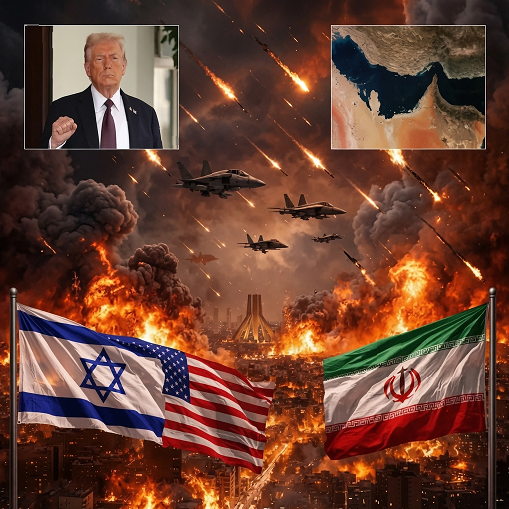
The situation described portrays a major escalation in tensions between the United States, Israel, and Iran, with military strikes, regional retaliation, and growing concerns over global energy security. According to the scenario, U.S. and Israeli forces launched coordinated attacks against Iranian military, missile, and nuclear-related facilities in an operation known as “Operation Epic Fury.” The strikes reportedly targeted key sites across Iran, including command centers, air defenses, and infrastructure linked to the Iranian government and the Islamic Revolutionary Guard Corps (IRGC). U.S. President Donald Trump and Israeli Prime Minister Benjamin Netanyahu justified the operation as a preemptive effort to eliminate perceived threats posed by Iran’s nuclear ambitions and regional activities.
Iran responded rapidly with missile and drone attacks against Israeli territory and multiple U.S. military installations across the Middle East. Bases in Qatar, the United Arab Emirates, Bahrain, Kuwait, Jordan, Iraq, and Saudi Arabia were reportedly among the targets. The attacks raised fears that the conflict could expand beyond a direct confrontation between Iran and Israel into a wider regional war involving numerous U.S. allies.
One of the most significant developments involved the Strait of Hormuz, one of the world’s most important maritime chokepoints. According to reports, Iran’s IRGC Navy issued warnings to commercial vessels, declaring that passage through the strait was unsafe or prohibited. Although Tehran stopped short of formally announcing a complete blockade, the warnings alone disrupted maritime traffic. Several shipping companies reportedly slowed operations, rerouted vessels, or suspended transit through the waterway entirely.
The Strait of Hormuz is strategically vital because roughly one-fifth of the world’s oil supply passes through it each day. Major energy exporters—including Saudi Arabia, Iraq, Kuwait, Qatar, and the UAE—depend heavily on the route. Any prolonged disruption could significantly affect global energy markets and supply chains.
Market analysts warned that oil prices could surge if the situation continued. Estimates suggested that crude oil prices could climb sharply, potentially reaching $100 per barrel or higher if shipping disruptions persisted. Higher energy costs would likely increase transportation and manufacturing expenses worldwide, placing pressure on consumers and national economies. Countries heavily dependent on Gulf energy exports, particularly in Asia, would face heightened economic risks.
The broader geopolitical implications are equally serious. Iran possesses asymmetric military capabilities, including naval mines, anti-ship missiles, drones, submarines, and fast-attack boats, allowing it to threaten shipping without directly confronting larger naval forces. At the same time, the United States has indicated it would act aggressively to keep the Strait of Hormuz open and protect commercial navigation.
Despite escalating rhetoric and military exchanges, analysts note that Iran faces a difficult balancing act. A complete closure of the strait would damage Iran’s own economy while risking overwhelming military retaliation. As a result, many observers believe Tehran may prefer limited disruption and pressure tactics rather than a sustained blockade.
As described, the crisis has generated worldwide concern because it combines military conflict, energy security risks, economic uncertainty, and the possibility of broader regional escalation. While shipping through the Strait of Hormuz reportedly continues at reduced levels, the situation remains fragile. Governments, markets, and international organizations are closely monitoring developments, recognizing that further escalation could have consequences extending far beyond the Middle East.