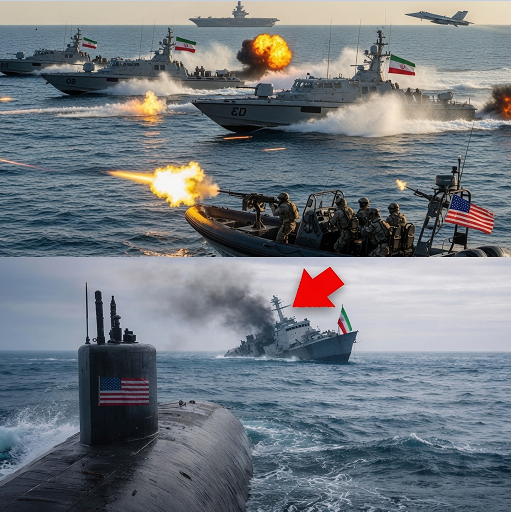
Persian Gulf, designed to emulate real-world special operations tactics while dramatizing a high-intensity naval engagement between U.S. forces and Iranian Revolutionary Guard fast attack craft.
The story begins with a covert nighttime deployment involving U.S. Navy SEAL teams launching from the USS Michael P. Murphy aboard Mark V Special Operations Craft. The mission takes place at 0345 hours and involves traveling at high speed across open waters toward the suspected location of three Iranian fast attack vessels. The narrative emphasizes stealth, timing, and precision, highlighting the strategic importance of maritime operations in the Persian Gulf, a region known for geopolitical tension and heavily trafficked shipping lanes.
The Iranian forces are described as operating Zolfaghar-class and Peykaap-class vessels, attempting to conceal themselves among civilian maritime traffic near the Tunb Islands. As dawn approaches, SEAL scout teams reportedly use thermal imaging to detect the boats. At 0615 hours, contact is made, and the Iranian craft split formation in an attempt to evade or ambush the approaching U.S. forces.
The engagement escalates rapidly. U.S. forces respond with coordinated firepower from Mark V craft equipped with .50 caliber machine guns, while an MH-60S Seahawk helicopter provides aerial support. The helicopter launches AGM-114 Hellfire missiles, which the narrative describes as destroying multiple Iranian vessels. One boat is said to be obliterated in a fuel explosion, another disabled by gunfire, and the third destroyed by a direct missile strike.
Within minutes, the fictional battle concludes with the complete destruction of the Iranian craft. The story claims no U.S. casualties, while Iranian forces suffer total losses, including killed and captured personnel. The engagement is presented as a decisive demonstration of U.S. naval superiority and SEAL operational effectiveness.
However, the passage explicitly clarifies that the scenario is fictional and intended for educational and entertainment purposes. It states that while the tactics described are inspired by real U.S. Navy SEAL doctrine and maritime interdiction strategies, the specific engagement did not occur.
Real-world references include platforms such as Mark V Special Operations Craft, MH-60S Seahawk, and weapons like the AGM-114 Hellfire missile, all of which are legitimate components of U.S. military capability. However, the narrative exaggerates their deployment into a cinematic, fully resolved battle scenario that is not supported by any verified military record.
In conclusion, the text is best understood as a stylized war simulation blending real equipment and tactics with fictional combat storytelling. It illustrates how modern military fiction often draws on authentic doctrine to create plausible but imaginary scenarios, emphasizing speed, coordination, and technological dominance.