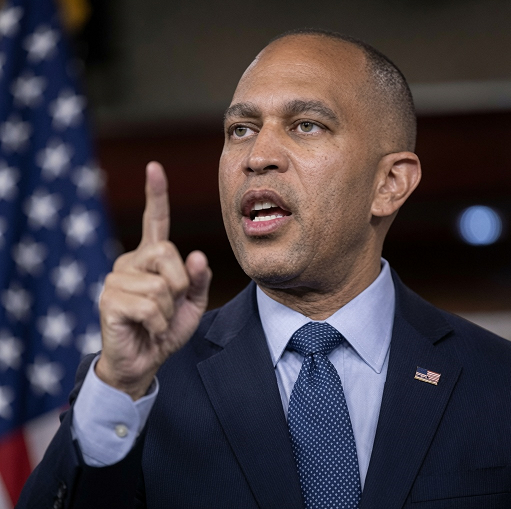
House Democratic Leader Hakeem Jeffries is facing renewed political scrutiny following a Virginia Supreme Court ruling that struck down the state’s newly approved congressional map, dealing a setback to Democratic redistricting efforts ahead of the 2026 elections.
The Virginia Supreme Court ruled 4–3 that the map was invalid because Democratic lawmakers failed to meet procedural requirements under the state constitution when placing the referendum before voters. The decision effectively voided what Democrats had hoped would be a 10–1 congressional advantage in the state and forced Virginia to redraw its districts ahead of the next election cycle.
Republicans quickly criticized the ruling’s implications and accused Democrats of attempting to overreach in the redistricting process. Conservative commentators also resurfaced earlier remarks made by Jeffries in which he defended the map, saying at the time that “the law is with us in Virginia.” Those comments have since drawn renewed attention following the court’s decision against the Democratic-backed plan.
The ruling represents a significant moment in a broader national struggle over congressional redistricting that has intensified ahead of the 2026 midterms. Both major parties have engaged in aggressive efforts to reshape district boundaries in states where they hold legislative control, aiming to secure electoral advantages in closely contested House races.
Republicans, who currently hold a narrow majority in the U.S. House of Representatives, have pursued redistricting changes in several states, including Texas, Louisiana, and Alabama. In Texas, Republican-led efforts—encouraged by President Donald Trump—resulted in maps designed to strengthen GOP electoral prospects. Similar initiatives in other states could potentially yield additional Republican-favored districts if they withstand legal challenges.
Legal battles have accompanied many of these efforts. While some Republican-backed maps have advanced, others have been blocked or delayed by courts. For example, a federal court recently blocked Alabama’s proposed map, though state officials have appealed to the Supreme Court.
Meanwhile, political analysts note that redistricting trends over the past year have generally favored Republicans, who may end up with a net gain of several House seats if pending maps are upheld. Analysts estimate that successful Republican efforts across multiple states could translate into a structural advantage in the upcoming election cycle.
Experts describe the broader redistricting environment as increasingly polarized and legally complex, with courts playing a decisive role in determining which maps are ultimately implemented. Observers also note that recent changes to Voting Rights Act interpretations have opened additional opportunities for states to redraw districts, further intensifying the national redistricting conflict.
As legal challenges continue and states finalize their maps, both parties are preparing for what is expected to be a highly competitive 2026 midterm election landscape shaped significantly by court decisions and redistricting outcomes.