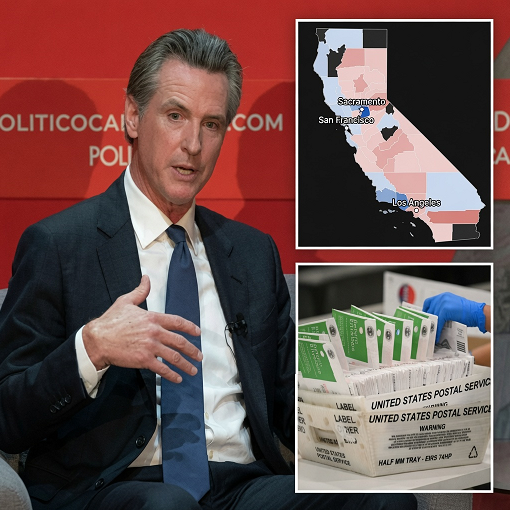
Primary elections across several California races drew significant attention as early results and ongoing ballot counts shaped expectations for the November general election, with multiple contests still drawing scrutiny and political debate.
In California’s 7th Assembly District, Republican incumbent Josh Hoover secured a strong lead in early results, receiving roughly 54% of the vote compared to Democratic challenger Amy Slavensky’s approximately 44%. The outcome positions both candidates to advance to the November general election under California’s top-two primary system, which allows the two highest vote-getters to move forward regardless of party affiliation. Hoover, who first won the seat when it flipped from Democratic to Republican control in 2022, has built a profile as a bipartisan-oriented lawmaker. He previously served as chief of staff to former Assemblyman Kevin Kiley and currently participates in the bipartisan California Problem Solvers Caucus. His opponent, Slavensky, re-entered public service after retirement, having previously served as a superintendent in California school districts.
Elsewhere in the state, attention focused heavily on the Los Angeles mayoral race, where incumbent Democrat Karen Bass failed to secure an outright majority of 51%, triggering a runoff election in November. Bass led the field with roughly 35% of the vote. She was followed by Republican candidate Spencer Pratt with about 29.9% and Democratic City Council member Nithya Raman with approximately 22.8%, based on partial vote counts. With Bass firmly in first place, the remaining uncertainty centered on whether Pratt or Raman would secure the second runoff position, as additional ballots continued to be counted. Analysts noted that Bass remains strongly positioned in the deeply Democratic city, though the final composition of the runoff is still being determined.
The slow pace of California ballot counting also became a political talking point, with critics questioning the extended timeline for finalizing results. State officials and Democratic leaders have defended the process, citing laws that allow for the counting of large numbers of mail-in and late-arriving ballots. Officials argue that these procedures are designed to maximize voter participation, even if they extend the reporting period beyond Election Day.
Adding to tensions in the mayoral race, Spencer Pratt publicly alleged possible election law violations by Mayor Bass, claiming that a campaign video may have constituted improper electioneering near a ballot drop box. Pratt filed a formal complaint and accused the mayor of violating state rules that restrict campaigning within 100 feet of ballot drop locations. Bass’s spokesperson dismissed the allegations and questioned their validity.
Across California, the combination of competitive races, ongoing ballot counts, and legal complaints highlighted both the complexity and contentiousness of the state’s election system. With several contests heading toward November runoffs, attention now shifts to how remaining ballots will be counted and how candidates will position themselves for the general election.