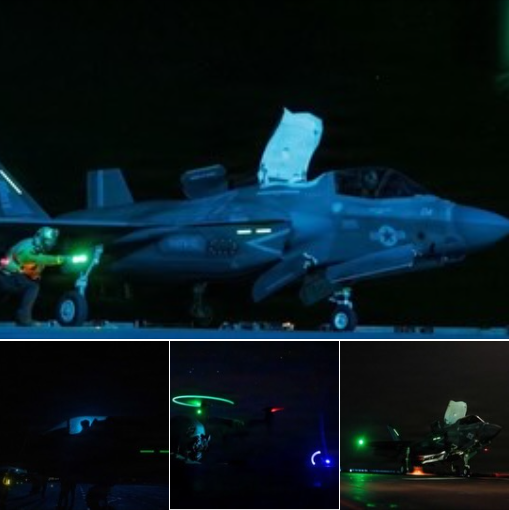
Photos released by United States Central Command (CENTCOM) provide a detailed look at ongoing flight deck operations aboard the USS Tripoli (LHA-7) in the Arabian Sea. The images highlight nighttime aviation activities, showcasing the operational readiness and capabilities of U.S. naval forces deployed within the CENTCOM Area of Responsibility.
The photographs feature advanced aircraft, including the F-35B Lightning II and the MV-22 Osprey, conducting coordinated flight operations under low-light conditions. These aircraft represent key components of modern U.S. expeditionary warfare, with the F-35B providing stealth, surveillance, and strike capabilities, while the MV-22 Osprey offers versatile troop transport and logistical support with its unique tiltrotor design.
Nighttime flight operations are among the most complex and demanding tasks for naval aviators and flight deck crews. The images emphasize the precision, coordination, and training required to safely launch, recover, and manage multiple aircraft in a confined and dynamic maritime environment. Deck crews can be seen guiding aircraft, managing equipment, and maintaining strict safety protocols despite limited visibility.
The USS Tripoli, an America-class amphibious assault ship, serves as a mobile sea base capable of supporting a wide range of missions, including air operations, amphibious assaults, and rapid response deployments. Its deployment in the Arabian Sea underscores the U.S. military’s ongoing presence in the region and its commitment to maintaining operational readiness amid evolving security challenges.
Overall, the released photos serve both as a demonstration of military capability and as a signal of U.S. presence in a strategically important area. They highlight the integration of advanced aviation platforms and naval assets working together to support regional stability, deterrence, and rapid response operations in a complex and often tense geopolitical environment.