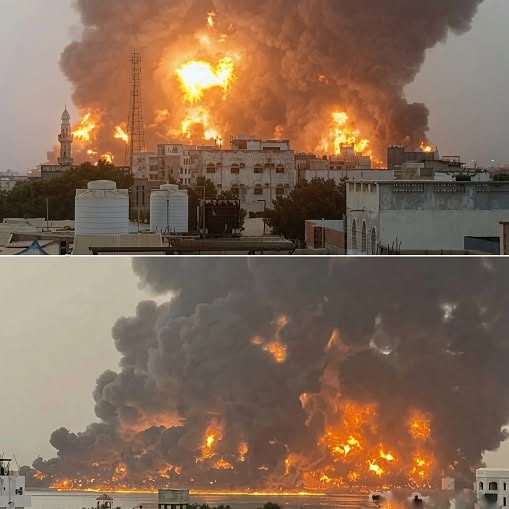
An Israeli airstrike on Yemen’s Houthi-controlled Hodeida port caused extensive damage estimated at more than $20 million, according to local port officials. The attack, carried out on July 20, 2024, marked the first time Israel publicly claimed responsibility for a direct military strike inside Yemen and represented a significant escalation in the conflict involving the Iran-backed Houthi movement.
The strike came one day after a Houthi drone attack struck Tel Aviv, killing an Israeli civilian. In response, dozens of Israeli aircraft targeted Hodeida, Yemen’s principal Red Sea port under Houthi control. Israeli officials stated that the operation focused on fuel storage facilities, energy infrastructure, and large container cranes that they alleged were being used to facilitate the transfer of Iranian weapons to the Houthis.
According to Houthi authorities, nine people were killed in the attack. The strikes triggered a massive fire that burned for several days and destroyed much of the port’s oil-storage capacity. Satellite imagery later showed large fuel tanks engulfed in flames, highlighting the scale of the damage.
Nasr al-Nusairi, vice president of the Yemen Red Sea Ports Corporation, said a preliminary assessment found that at least two of the port’s four major container cranes were destroyed, a small vessel was burned, several buildings were damaged, and parts of the docking infrastructure were affected. He estimated direct port damage at more than $20 million, noting that this figure did not include losses related to the destruction of fuel storage facilities, which fall under the responsibility of Yemen’s oil authorities. As a result, the total economic cost is expected to be significantly higher.
Despite the destruction, Houthi officials emphasized that operations resumed relatively quickly. The first container ships reportedly arrived just three days after the strike, and port activities gradually returned to normal. Journalists visiting the area observed ships unloading cargo and workers operating remaining equipment, suggesting that the port retained at least partial functionality despite the damage.
The Israel Defense Forces described the operation as a major blow to the Houthis’ economic and logistical capabilities. Israeli officials argued that disabling key infrastructure, particularly the cranes, would hinder the group’s ability to import weapons and military supplies from Iran. The strike was therefore presented not only as retaliation for the Tel Aviv drone attack but also as an effort to disrupt the Houthis’ broader military network.
The incident occurred amid growing regional tensions linked to the war between Israel and Hamas in Gaza. Since November 2023, the Houthis have launched attacks on commercial shipping in the Red Sea and Gulf of Aden, claiming solidarity with Palestinians in Gaza. These actions have disrupted international trade and prompted military responses from the United States and the United Kingdom. However, the strike on Hodeida was the first direct Israeli attack against the Houthis since the group began targeting ships and Israeli-linked interests.
The attack highlights the increasingly regional nature of the conflict, demonstrating how violence connected to the Gaza war has expanded beyond Israel and the Palestinian territories. While Hodeida remains operational, the strike inflicted substantial economic damage and underscored the growing risks of escalation across the Middle East.