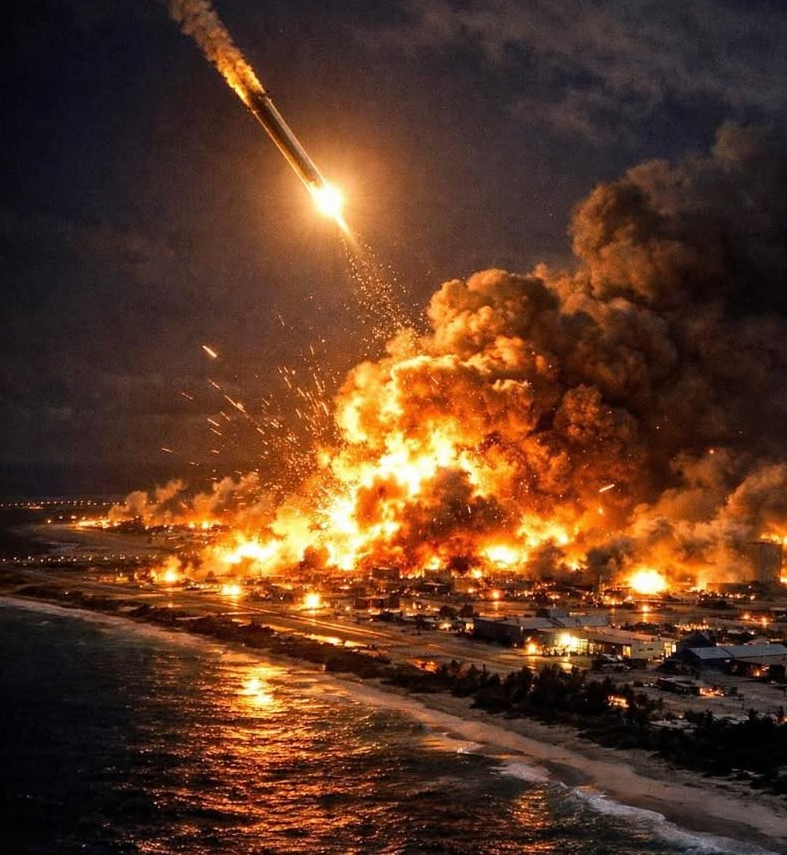
A viral claim recently circulated online alleging that Iran had launched a missile strike on the U.S.-U.K. military facility at Diego Garcia in the Indian Ocean.
The reports described a long-range missile allegedly traveling thousands of kilometers and causing significant damage to the strategic base. The claim spread quickly across social media platforms due to its dramatic framing and the high geopolitical stakes implied by any direct attack on a major military installation.
However, there is currently no verified evidence from reputable international news organizations, official government statements, or defense agencies confirming that such an attack has occurred. Established outlets such as major global newspapers and wire services have not reported any incident matching these claims. In situations involving real military action of this scale, confirmation would normally appear almost immediately from multiple independent sources, including governments, defense ministries, and international monitoring organizations. The absence of such reporting strongly indicates that the claim is unverified and likely inaccurate or exaggerated.
The attention the rumor received is partly due to the strategic importance of Diego Garcia.
Located in the central Indian Ocean, the island serves as a joint United States and United Kingdom military facility and is considered a key logistics and operations hub. It supports long-range bomber missions, naval operations, intelligence gathering, and regional security coordination across the Indo-Pacific and Middle East regions. Because of this role, any credible attack on the base would represent a major international crisis and would be expected to generate immediate global coverage and official responses.
The claim also referenced a missile allegedly capable of traveling around 4,000 kilometers, which falls into the category of intermediate-range ballistic missiles. Missile systems are generally classified by range: short-range missiles typically travel under 1,000 kilometers, medium-range systems extend up to around 3,000 kilometers, intermediate-range missiles reach up to 5,500 kilometers, and intercontinental systems exceed that range. While several countries have developed increasingly advanced missile technology, any confirmed long-range strike on a distant overseas base would be an extraordinary event with immediate and widespread geopolitical consequences.
Experts emphasize that claims involving advanced military capabilities and large-scale attacks should always be treated with caution until verified.
Modern misinformation often spreads rapidly due to emotionally charged headlines, vague sourcing, and the use of authoritative names without direct citations. Social media platforms amplify such content because dramatic stories generate high engagement, often outpacing fact-checking mechanisms.
In this case, the lack of confirmation from official sources or credible media strongly suggests the claim is not reliable. If a missile strike on Diego Garcia had occurred, it would almost certainly be confirmed through multiple independent channels, including defense officials, satellite data, and international news agencies. The absence of such evidence is a key indicator that the story is likely based on speculation or fabrication.
The broader issue highlighted by this claim is the growing challenge of misinformation in global security reporting.
Military-related rumors can spread quickly because they evoke fear and urgency, but they can also distort public understanding of real-world events. Analysts stress the importance of relying on verified reporting, particularly from established news organizations and official government communications, when assessing claims of conflict or military action.
Responsible information consumption requires verifying multiple sources before accepting or sharing breaking news.
This includes checking whether reputable outlets have reported the event, whether official statements have been issued, and whether there is any supporting evidence such as satellite imagery or verified footage. Without these elements, claims remain speculative.
Ultimately, the alleged missile strike on Diego Garcia serves as a reminder of how quickly unverified information can circulate in the digital age. While geopolitical tensions do exist in various regions, accurate reporting depends on evidence, confirmation, and careful analysis rather than viral narratives. Maintaining a critical approach to sensational claims helps prevent misinformation and ensures a clearer understanding of international events.