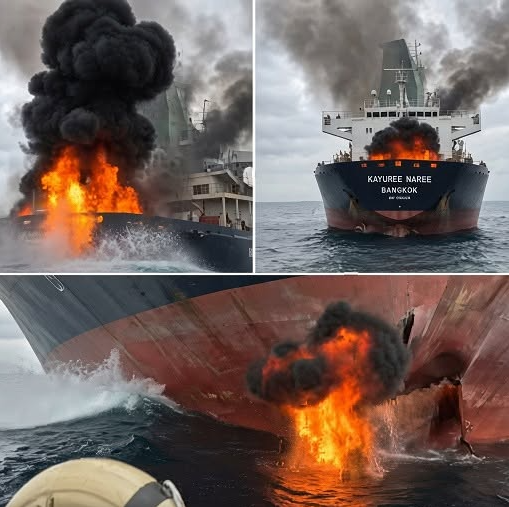
Hormuz has raised serious concerns after reports emerged that commercial vessels were attacked while attempting to pass through the strategic waterway.
The Strait, a critical maritime chokepoint connecting the Persian Gulf to the Gulf of Oman, is essential for global energy transport, handling roughly one-fifth of the world’s oil supply.
According to reports, tensions intensified after Iranian officials warned that ships associated with the United States, Israel, or their allies could be treated as “legitimate targets” if they entered the area without authorization. Following these warnings, multiple commercial vessels reportedly came under fire, allegedly from Iran’s Islamic Revolutionary Guard Corps (IRGC).
Among the affected ships, a Thai-flagged bulk carrier was struck and caught fire in its engine room, forcing crew members to evacuate parts of the vessel. Two additional ships, registered in Japan and the Marshall Islands, were also hit but sustained less severe damage. While no large-scale casualties have been confirmed, the incidents triggered immediate safety alerts and ongoing investigations by maritime authorities.
The attacks prompted widespread disruption in commercial shipping. Several vessels slowed, altered course, or anchored to avoid further risk.
Insurance companies have raised risk classifications for the region, significantly increasing premiums for ships transiting the Gulf. Governments and shipping organizations have issued warnings urging caution or temporary avoidance of the strait.
The strategic importance of the Strait of Hormuz means that even limited disruptions can have global consequences. Energy-exporting countries such as Saudi Arabia, the United Arab Emirates, Kuwait, and Iraq rely heavily on this route, and any interference can affect international oil markets, increase fuel prices, and disrupt supply chains.
The incident also unfolds amid broader regional military tensions, including reported U.S. and allied strikes on Iranian targets and retaliatory missile and drone launches.
Analysts warn that attacks on civilian shipping could mark a dangerous expansion of the conflict, increasing the risk of wider escalation.
International leaders have called for restraint and the protection of civilian maritime traffic, emphasizing that freedom of navigation is essential to global economic stability. As investigations continue, the situation in the Strait of Hormuz remains highly volatile, with global markets and governments closely watching for further developments and signs of either de-escalation or broader confrontation.