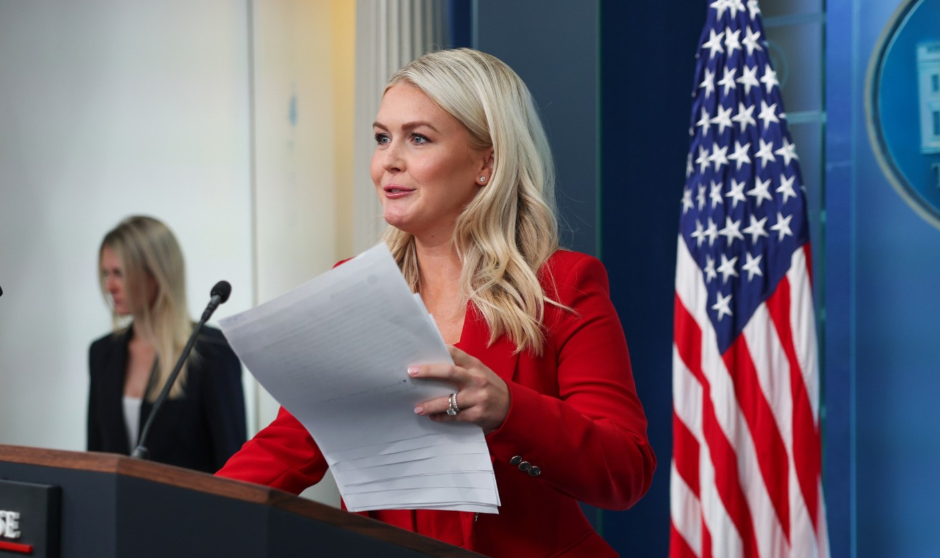
White House Press Secretary Karoline Leavitt provided an update on Thursday on President Donald Trump’s possible nuclear deal with Saudi Arabia.
While speaking to reporters at the press briefing, Leavitt revealed that the deal was contingent on Saudi Arabia joining the Abraham Accords.
Leavitt read Trump’s Thursday morning Truth Social post about the contingency to reporters, that said in part, “The civil nuclear deal, there will be no enrichment of material, an important point being made between the Department of Energy and Saudi Arabia, which pertains only to non-military use, will be approved, but is totally subject to Saudi Arabia joining the very respected and successful Abraham Accords.”
Leavitt emphasized, “Yes, this deal with Saudi Arabia, the energy deal, is contingent on this condition, as far as the president is concerned.”
NBC News correspondent Gabe Gutierrez asked, “Why was that condition not mentioned yesterday when the Energy secretary announced it?”
“Look, the president is always the final deal maker, as you know, and this is something he has mentioned on numerous occasions going back. I can provide you with those statements, and he has said if they don’t join the Abraham Accords the deal is off. So we’ll continue to have those conversations with our Saudi counterparts moving forward,” Leavitt answered.
“So, the deal is dead if Saudi Arabia doesn’t join in? And have you any indication that Saudi Arabia is even considering this?” Gutierrez followed up.
“No, again, the president has spoken directly with the Saudis about this in numerous conversations in the past, and the administration will continue to engage in those conversations,” Leavitt maintained.
Leavitt called on the next reporter, but Gutierrez pressed, “Will they be exempt from international inspections as part of this deal as it moves forward?”
“I don’t want to comment on the specifics of the deal,” said a more agitated Leavitt. “As we’re still again, as I just said, talking, especially about this very important condition the president raised this morning.”
Following questions about other topics, The Wall Street Journal’s Meridith McGraw asked, “Just to continue on the Saudi nuclear deal. Do the Saudis agree with this interpretation since it wasn’t part of the initial agreement? And has the president talked to MBS since the new condition?”
“As you know, the president just put out this statement a few hours ago. I don’t believe he have has had a call with MBS in the hours since, however he raised this in previous conversations and has also said many times in the past,” Leavitt said.
The next reporter asked, “In regards to this deal, in the past the Saudi government has said they will not consider entering into the Abraham Accords unless and until there is a Palestinian state. What makes you think that they will change their minds on their position regarding that?”
“Again, I won’t get ahead of the president’s conversations, but this is something that he feels very strongly about and has spoken about in the past and will continue to uphold,” Leavitt repeated.
“Just playing devil’s advocate, why does Saudi Arabia get a civilian nuclear deal Iran doesn’t get a civilian nuclear deal?” the reporter pressed.
WATCH:
This comes as President Trump gave Iran multiple opportunities to avoid the current conflict with the United States months before it began.
After the war started, the administration continued to reach out to the surviving regime in Tehran, offering one olive branch after another.
But even after agreeing to a 60-day ceasefire in late June, the Iranians continued to attack commercial tankers and shipping, which then led to a new wave of strikes by the U.S., which is now in its ninth day.
That said, Secretary of State Marco Rubio noted on Sunday that the United States remains open to diplomacy with Iran.
Rubio said Sunday night that Iran had effectively ended a memorandum of understanding intended to keep the Strait of Hormuz open after Tehran attacked multiple commercial vessels, while emphasizing that the United States remains willing to pursue a diplomatic resolution.
Speaking with reporters at Joint Base Andrews before departing for the Philippines for the ASEAN foreign ministers’ meeting, Rubio said Iran had been expected to reaffirm its commitment to keeping the strategic waterway open to commercial shipping and to cease attacks on vessels.
When asked if the memorandum of understanding was truly dead, Rubio stated that Iran had already answered that question through its actions.
“They’re not complying with it,” Rubio said.
“The straits are supposed to be open, free of tolls, free of attack, free of all the things they’re doing against these ships,” he continued, per Fox News.
Nevertheless, Rubio said the U.S. is still willing to sit down and discuss peace terms with the Iranians, but their behavior will have to change first.