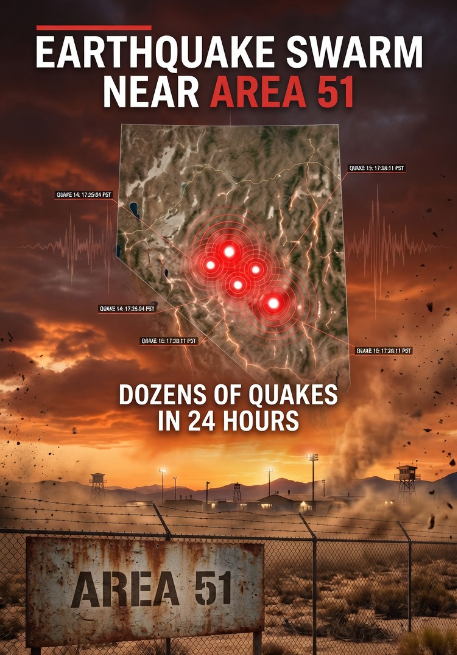
Over the past 24 hours, a cluster of small earthquakes has reportedly been recorded in southern Nevada near the broader region associated with Area 51. While headlines often focus on the famous name, this kind of seismic activity is usually explained by normal geology rather than anything mysterious.
Nevada is actually one of the most earthquake-prone states in the United States. It lies within the Basin and Range Province, where the Earth’s crust is slowly stretching. That stretching creates many faults, which regularly produce swarms of small earthquakes. These swarms can involve dozens of minor quakes over hours or days, often without causing damage.
When several earthquakes happen close together, it generally means stress is being redistributed along nearby faults underground. That can sound dramatic, but it is a common natural process. Many of the events in these swarms are too weak to be felt by people and are only detected by seismic instruments.
The region around Nevada has a long history of similar activity. Earthquake clusters happen near places such as Reno, Las Vegas outskirts, and remote desert fault zones. Because Area 51 is well known in popular culture, any nearby activity tends to attract extra attention online.
Importantly, a swarm does not automatically mean a larger earthquake is imminent. Sometimes swarms fade away quickly; sometimes they continue intermittently. Scientists monitor patterns such as magnitude increases, depth changes, and fault movement to assess whether risk is changing.
So while “unusual seismic activity near Area 51” sounds dramatic, the most likely explanation is ordinary tectonic movement in an active desert region—not secret underground events.
If you’d like, I can also check the latest verified USGS earthquake data for Nevada today and tell you exactly how many quakes occurred, their magnitudes, and how close they were to Area 51.