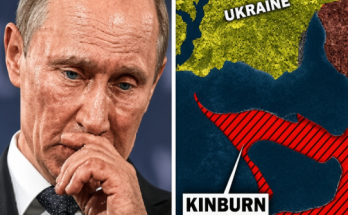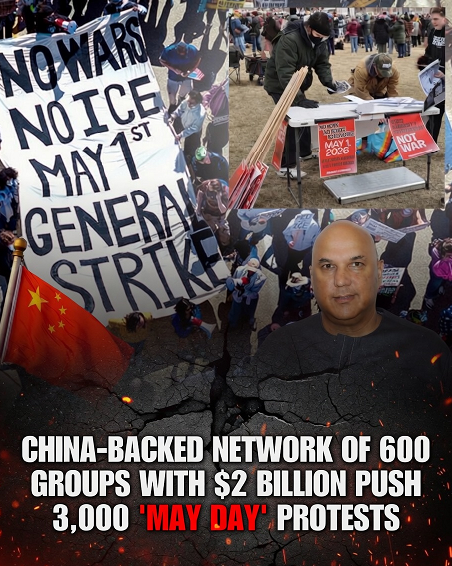
Roughly 600 organizations across the United States planned coordinated May Day demonstrations, with organizers claiming around 3,000 separate protests and events nationwide. According to the report, these actions were framed around slogans such as “Workers Over Billionaires” and encouraged participants to skip work, school, and shopping. The demonstrations were described as one of the largest May Day mobilizations in recent years, blending labor activism, anti-Trump protest messaging, and broader left-wing political causes.
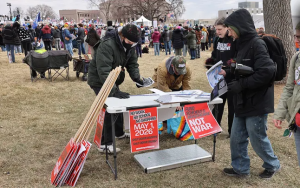
The piece characterizes the coalition as a “red-blue” alliance, referring to cooperation between socialist or communist groups (“red”) and Democratic-aligned organizations (“blue”). It says communist, socialist, Marxist, and far-left groups such as the Democratic Socialists of America, the Party for Socialism and Liberation, ANSWER Coalition, Code Pink, and the People’s Forum played central organizing roles. Some of these groups were linked in the article to businessman Neville Roy Singham, an American-born tech entrepreneur based in Shanghai, whom critics accuse of supporting causes aligned with Chinese Communist Party narratives.
At the same time, the article states that more mainstream Democratic-aligned organizations also participated or promoted events. These included Indivisible, MoveOn.org, the American Federation of Teachers, the AFL-CIO, the National Education Association, and several state or local Democratic Party affiliates. Examples cited include the California Democratic Party, Ohio Democratic Party Progressive Caucus, Young Democrats chapters in Wisconsin and North Carolina, and county-level Democratic committees.

Organizers said the demonstrations focused on economic inequality, labor rights, immigration, and opposition to corporate influence. Their stated demands reportedly included “Tax the rich,” “No ICE. No War,” and calls to expand democracy while limiting corporate power. Supporters framed the movement as resistance to what they described as authoritarianism and billionaire control of government. Some organizers predicted more than 100,000 student walkouts in addition to labor-related actions.
The article, however, presents a strongly critical interpretation of the coalition. Critics quoted in the report argued that Democratic organizations were allowing May Day’s labor tradition to be overtaken by fringe socialist groups. Democratic strategist Melissa DeRosa said the Democratic Party once focused on wages, dignity, family, and upward mobility but is increasingly embracing protest politics and slogans rather than practical policy solutions. She warned that such an approach could alienate moderate voters and weaken the party electorally.
The report also linked the May Day protests to earlier anti-Trump “No Kings” rallies, saying many of the same activist networks were involved. It further referenced alleged would-be assassin Cole Allen, claiming he attended a “No Kings” protest before an attempted attack on President Trump, though no evidence was presented tying organizers to the violence.
Overall, the article portrays May Day 2026 as both a major national protest effort and a sign of growing overlap between progressive Democratic activism and more radical left-wing movements. Supporters view it as mass mobilization for workers and democracy, while critics see it as evidence of ideological drift and increasingly confrontational protest politics.