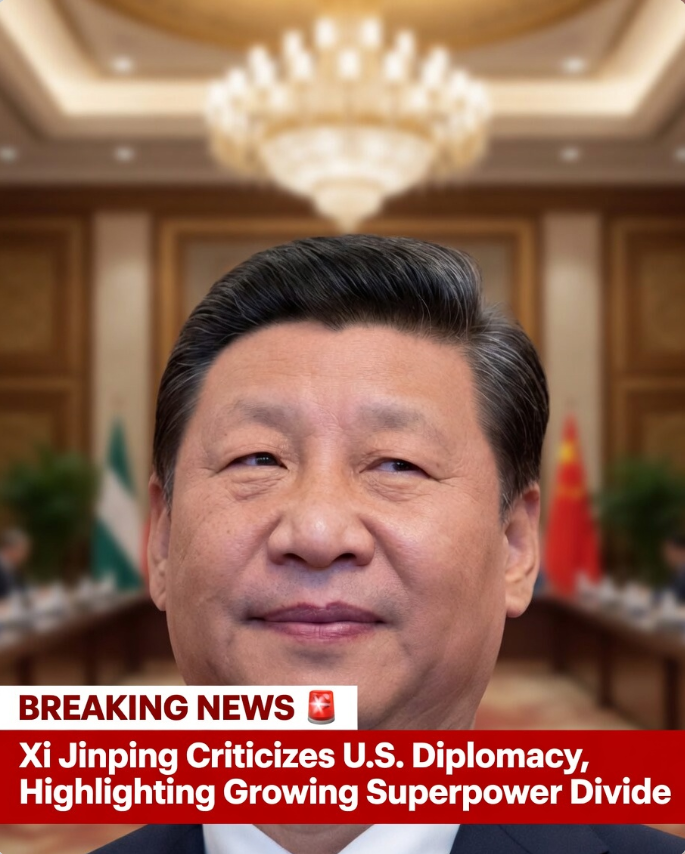
Chinese President Xi Jinping has issued a pointed critique of American foreign policy, arguing that China prioritizes building international partnerships and “global friendships,” while the United States, in his view, continues to alienate other nations and “create enemies.” His comments reflect an ongoing narrative from Beijing that contrasts China’s diplomatic approach with that of Washington.
The remarks come amid heightened geopolitical tensions and broader competition between the two superpowers, with both sides increasingly framing their international roles in sharply different terms. Xi’s statement suggests that China sees itself as promoting cooperation and stability, while portraying the United States as relying on confrontation and divisive alliances.
This rhetoric highlights a widening ideological divide between the two countries, particularly in how each interprets global leadership and influence. China’s messaging emphasizes multilateral cooperation, economic connectivity, and diplomatic engagement, whereas the U.S. is often characterized in Chinese discourse as pursuing strategic competition and security-focused alliances.
The statement also reflects broader efforts by both nations to shape global perception and influence international opinion. By emphasizing contrasting diplomatic philosophies, Chinese leadership seeks to position itself as a stabilizing global actor, while critiquing American policies as counterproductive to global unity.
Analysts note that such exchanges contribute to ongoing tensions in international relations, reinforcing mutual distrust and competing narratives. However, they also point out that rhetoric of this kind is often part of broader strategic communication rather than a direct indication of immediate policy changes.
Overall, the comments underscore the continued rivalry between the two powers and the increasing importance of narrative framing in global diplomacy, as both countries seek to define their roles on the world stage amid evolving geopolitical challenges.