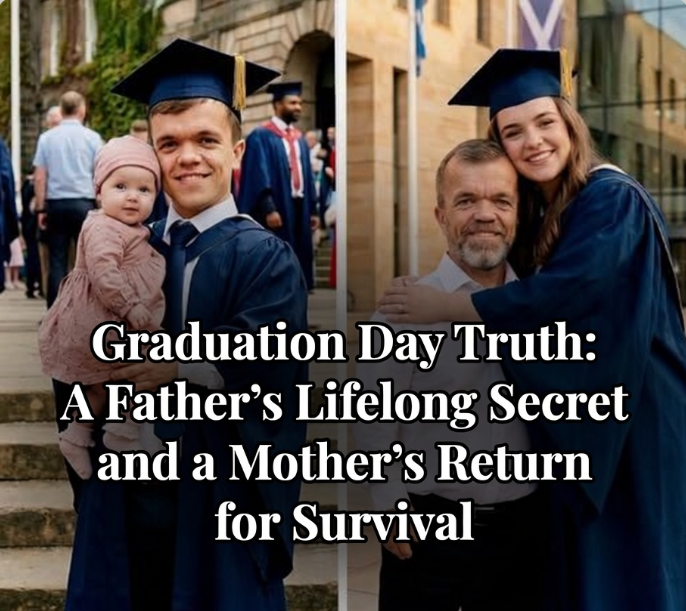
The story centers on a young woman reflecting on a framed photograph in her home that has come to symbolize her entire upbringing. The image shows her teenage father standing on a high school football field at his graduation, holding her as an infant in his arms. For most of her life, she believes the story behind it: that her biological mother abandoned her at three months old, leaving her in a bicycle basket with a note saying she could no longer care for her. Her father, then only 17, chose to raise her alone despite having no preparation or support.
The narrative describes her father’s lifelong sacrifices—working construction, delivering food at night, abandoning college plans, and learning parenting skills on his own. He becomes a devoted single parent, ensuring she never feels unwanted. He raises her with emotional stability and care, even as a teenager himself, and the photograph becomes a symbol of his commitment and endurance.
On the daughter’s graduation day, she invites her father to attend with her. However, the ceremony is disrupted when a woman appears in the crowd and directly confronts them. She claims the father is a liar and accuses him of kidnapping the daughter. The situation escalates into public chaos until a former teacher intervenes and provides crucial context: the woman, Liza, is actually the biological mother who had abandoned the child as an infant, leaving her temporarily with the father before disappearing permanently.
The father then confesses that he is not biologically related to the girl and had concealed the truth to protect her from feeling unwanted. He admits he raised her out of choice, not obligation, fearing that the truth about her abandonment would harm her sense of identity. This revelation deeply reshapes the daughter’s understanding of her past.
The story takes another turn when Liza reveals she is dying of leukemia and has returned not out of remorse but in hopes of finding a bone marrow match. She pleads publicly for help, intensifying the emotional conflict. The daughter agrees to get tested, not out of obligation to Liza, but as an act of compassion shaped by her upbringing.
In the end, the story emphasizes that parenthood is defined not by biology but by commitment and sacrifice. The father is ultimately recognized as her true parent, having chosen her from the beginning and devoted his life to raising her with unconditional love.