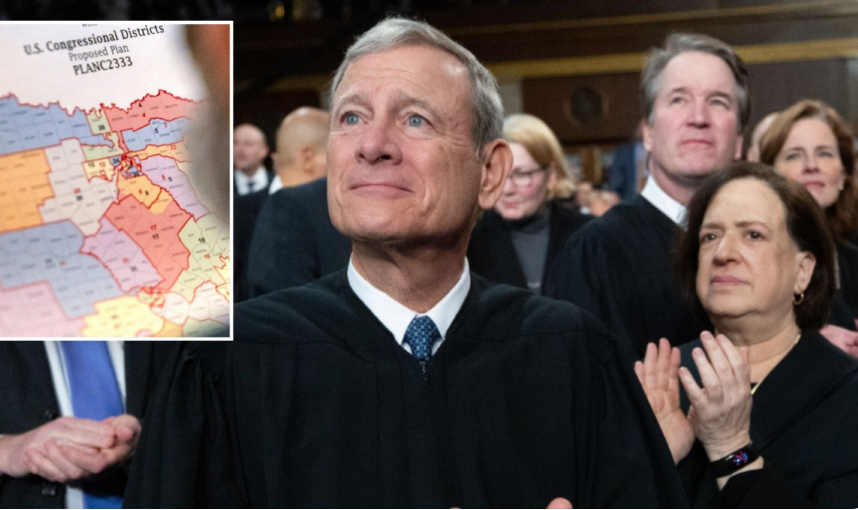
Decision by the Supreme Court of the United States that favored Republicans by overturning a lower-court ruling which had blocked Texas from redrawing its congressional districts. The ruling represents another significant development in a broader national battle over redistricting ahead of future elections.
According to the article, the Court relied on reasoning from the earlier case Abbott v. League of United Latin American Citizens, though the exact legal rationale was not detailed in the text. The three liberal justices—Sonia Sotomayor, Elena Kagan, and Ketanji Brown Jackson—reportedly dissented.
The Court had previously given temporary approval to Texas’s revised map in December and to a California map in February. Those approvals reflected mid-cycle redistricting efforts by both Republican-led and Democratic-led states. The article claims the Texas and California changes roughly offset one another in terms of partisan advantage before the 2026 midterms.
The dispute began after Greg Abbott asked the Supreme Court to halt a ruling from a three-judge federal panel in the Western District of Texas. That lower panel had found, by a 2–1 vote, that race played too significant a role in Texas’s redraw.
The United States Department of Justice also supported Texas in the appeal, arguing that the redraw was motivated by partisan goals rather than racial discrimination. Voting-rights groups challenging the map contended that it constituted an illegal racial gerrymander.
The unsigned Supreme Court order reportedly stated that the lower court should not have interfered during an active primary campaign, citing confusion and disruption to the balance between state and federal elections.
The article then shifts to another redistricting conflict in Virginia. There, a voter-approved referendum to redraw congressional districts was blocked by Jack Hurley Jr., who ruled that procedural violations occurred when the measure was placed on the ballot. Republicans argue both that the process was flawed and that the resulting map would be an unconstitutional partisan gerrymander favoring Democrats.
The case is now headed to the Supreme Court of Virginia, where justices are expected to consider whether the referendum complied with the state constitution and election laws.
Overall, the text portrays ongoing legal fights in Texas and Virginia as part of a nationwide struggle over congressional maps, with control of the United States House of Representatives potentially affected by these disputes.