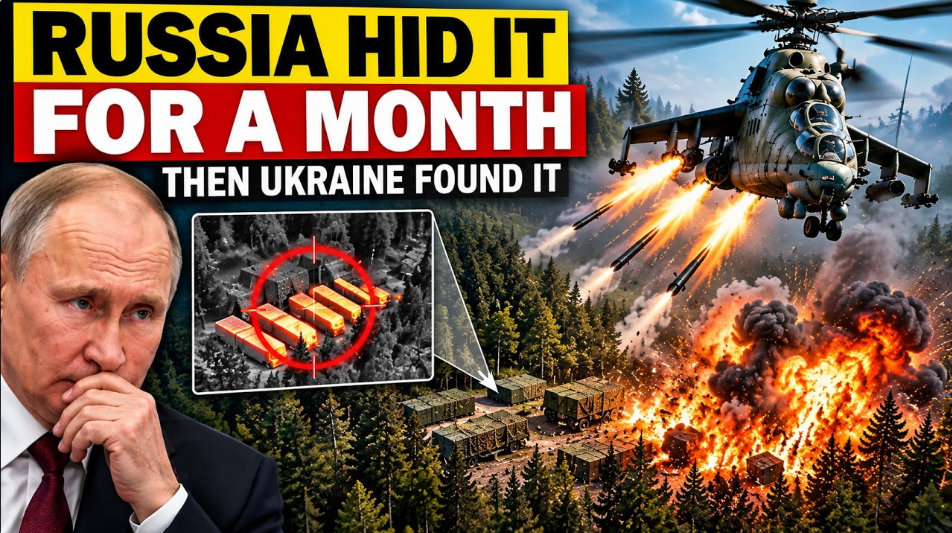
For weeks, Russian forces relied on camouflage, dense pine forest, and terrain masking to hide a forward ammunition cache supplying BM-21 Grad rocket launchers. Ukrainian optical reconnaissance drones repeatedly searched the area but found no obvious signs of the concealed position. The forest appeared quiet, demonstrating how effectively traditional visual surveillance can be defeated by concealment.
The breakthrough came during a narrow thermal crossover window at dawn. As temperatures changed, thermal imaging revealed heat signatures that remained invisible to ordinary optical cameras. Ukrainian reconnaissance operators used the thermal data to identify and confirm a suspected ammunition storage site hidden beneath the forest canopy.
Once the target was located, the challenge became striking it before the opportunity disappeared. Ukrainian forces had limited options for attacking a dispersed ammunition cache, and artillery was unable to provide the desired response quickly enough. Instead, an MI-24 Hind attack helicopter was selected for a low-level strike. Flying close to the terrain helped reduce exposure to enemy detection while allowing the helicopter crew to receive targeting information from the reconnaissance drone.
The mission illustrates how reconnaissance and attack platforms can work together. Rather than relying solely on an expensive precision weapon, the Hind used unguided rockets to saturate the suspected ammunition area. For a dispersed target hidden among trees, the ability to deliver multiple rockets across a wider area could be more suitable than attempting to place a single missile precisely on one location.
The strike triggered a series of explosions as stored ammunition was ignited, disrupting the logistics network supporting Russian rocket-launcher operations. Beyond the immediate destruction, the attack demonstrated the importance of identifying vulnerable supply points behind the visible frontline.
The operation also highlights a broader lesson from modern warfare: technological advantage does not always come from the newest or most sophisticated weapon. Effective reconnaissance, thermal sensing, terrain awareness, and rapid coordination can create opportunities that would otherwise remain hidden.
In this case, the decisive moment came when Ukrainian operators recognized the brief thermal window and acted before the concealed position could disappear again. The combination of drone surveillance and a low-flying helicopter transformed a hidden ammunition cache into a vulnerable target, showing how finding the right weakness can be just as important as the weapon used to exploit it.