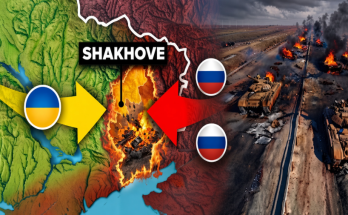
Ukraine launched 36 AN-196 Liutyi long-range attack drones from Kharkiv Oblast toward the NORSI oil refinery in Kstovo, Nizhny Novgorod — roughly 620 miles inside Russia.
But reaching the refinery meant surviving one of the most layered air-defense networks in the world. The first Russian S-400 battery detected the swarm near the Kursk border and immediately faced an uncomfortable equation: 32 ready-to-fire missiles against 36 incoming drones. Eight 48N6 missiles were launched, but only six Liutyi were destroyed. The surviving UAVs continued northeast. Buk-M3 and S-350 Vityaz batteries engaged next, launching additional surface-to-air missiles as the drones hugged the terrain at extremely low altitude. Russia then changed tactics and sent a Su-30SM2 fighter to intercept the formation from above. Using R-77M and R-73 air-to-air missiles, the fighter destroyed 11 drones — yet 15 Liutyi still escaped.
Then the mission nearly collapsed for a completely different reason. A navigation error near Shilovo pulled the formation almost 20 miles off course. More drones were lost to a Tor-M2 battery, engine trouble, and fuel exhaustion. By the time the surviving UAVs approached Nizhny Novgorod, only nine remained. Then came Russia’s Pole-21 electronic warfare network. GNSS interference caused two more Liutyi to crash. Ukraine responded by diverting one surviving drone toward an R-340RP transmitter cluster, creating a temporary gap in the jamming coverage and allowing six UAVs to continue toward Kstovo. At the NORSI refinery, Pantsir-S1 became the final defensive layer.
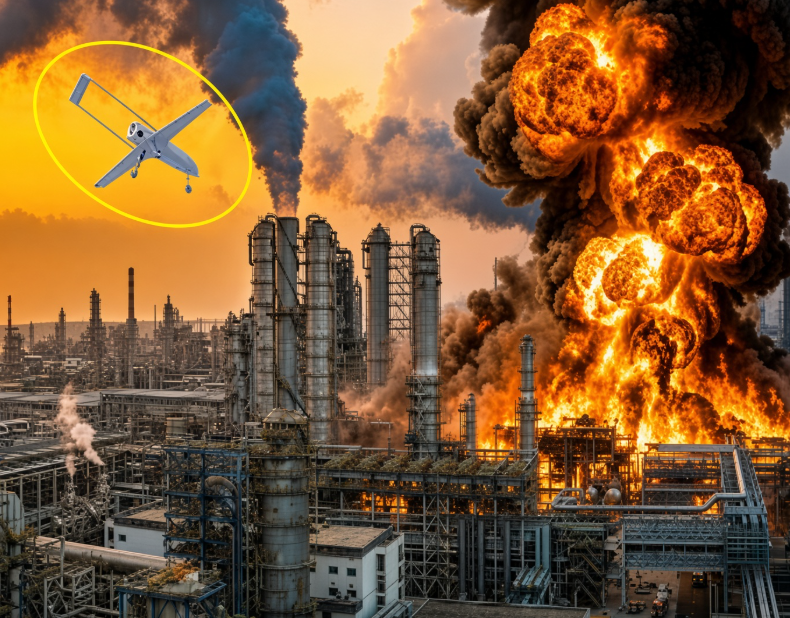
Two Liutyi were destroyed by 57E6 missiles. Another was cut down by the Pantsir’s twin 30 mm 2A38M autocannons. Three remained. Those final three UAVs entered their terminal dives from different directions and struck refinery process equipment, fuel pumping infrastructure, pipelines, and petroleum transfer areas. The resulting hydrocarbon fires spread beyond the initial impact points, forcing emergency shutdowns and sending flames and black smoke hundreds of feet above Kstovo. Only three of the original 36 drones reached their targets. But that was enough. This episode examines the economics and tactics of long-range UAV saturation attacks: how relatively inexpensive drones can force defenders to expend costly surface-to-air missiles, scramble fighter aircraft, activate electronic warfare systems, and still leave strategic infrastructure vulnerable if even a handful penetrate the final defensive layer.
Which Russian defensive layer played the most important role in stopping the swarm — S-400, Buk-M3, S-350, the Su-30SM2, Pole-21, or Pantsir-S1? And what could Russia have done differently to stop the final three Liutyi?