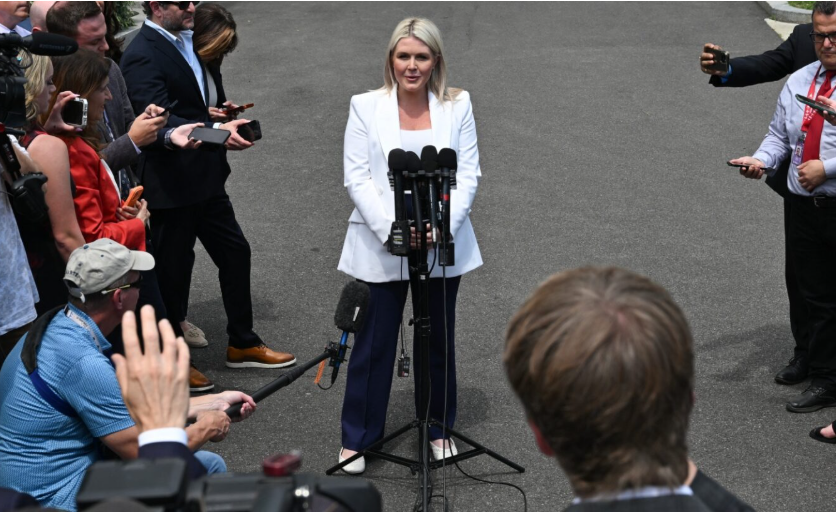
White House Press Secretary Karoline Leavitt is expected to take maternity leave in the coming days as she prepares to give birth to her second child. The administration has confirmed that she will step away from the podium temporarily, though no specific timeline has been provided for her return. Her absence is prompting a temporary shift in how the White House conducts daily press briefings.
Rather than appointing an interim press secretary, officials say the administration will use a rotating system in which multiple senior figures share briefing duties. This group is expected to include Cabinet members, Vice President JD Vance, and potentially President Donald Trump himself for select appearances. The approach is intended to maintain continuity in communications while allowing flexibility based on scheduling and topic expertise.
The White House communications office will continue operating under existing leadership during this period. Communications Director Steven Cheung will oversee the press operation alongside Leavitt’s staff, ensuring that messaging and media coordination remain consistent. A broad team of deputy press secretaries and communications aides will continue handling day-to-day responsibilities behind the scenes.
Officials have not established a fixed briefing schedule during Leavitt’s leave. Instead, briefings will be arranged depending on availability and subject matter relevance. This represents a departure from the traditional model in which a single press secretary regularly leads daily press conferences.
The decision to potentially have President Trump participate directly in briefings is notable. While presidents occasionally address the press in formal or informal settings, it is uncommon for them to routinely conduct White House press briefings. If implemented, this approach would give the president a more direct role in shaping the administration’s daily messaging.
The administration has framed the arrangement as a practical solution that ensures uninterrupted communication while accommodating Leavitt’s leave. Officials emphasized that she is expected to resume her duties after childbirth, though no official date has been set.
Reporting indicates that several internal communications officials are seen as capable of stepping into more visible roles during this period. Deputy Press Secretary Anna Kelly has been cited as a leading internal figure, alongside Assistant Press Secretary Taylor Rogers and Regional Press Secretary Liz Huston. Each has prior experience in political communications and has worked closely with Leavitt since the beginning of the administration.
The broader communications team includes numerous staff members responsible for coordinating messaging, managing media inquiries, and supporting senior officials. Their continued involvement is expected to ensure stability during the transition.
Overall, the temporary restructuring reflects an effort by the White House to maintain consistent public messaging while adapting to the press secretary’s short-term absence, using a more distributed model of communication rather than a single spokesperson.