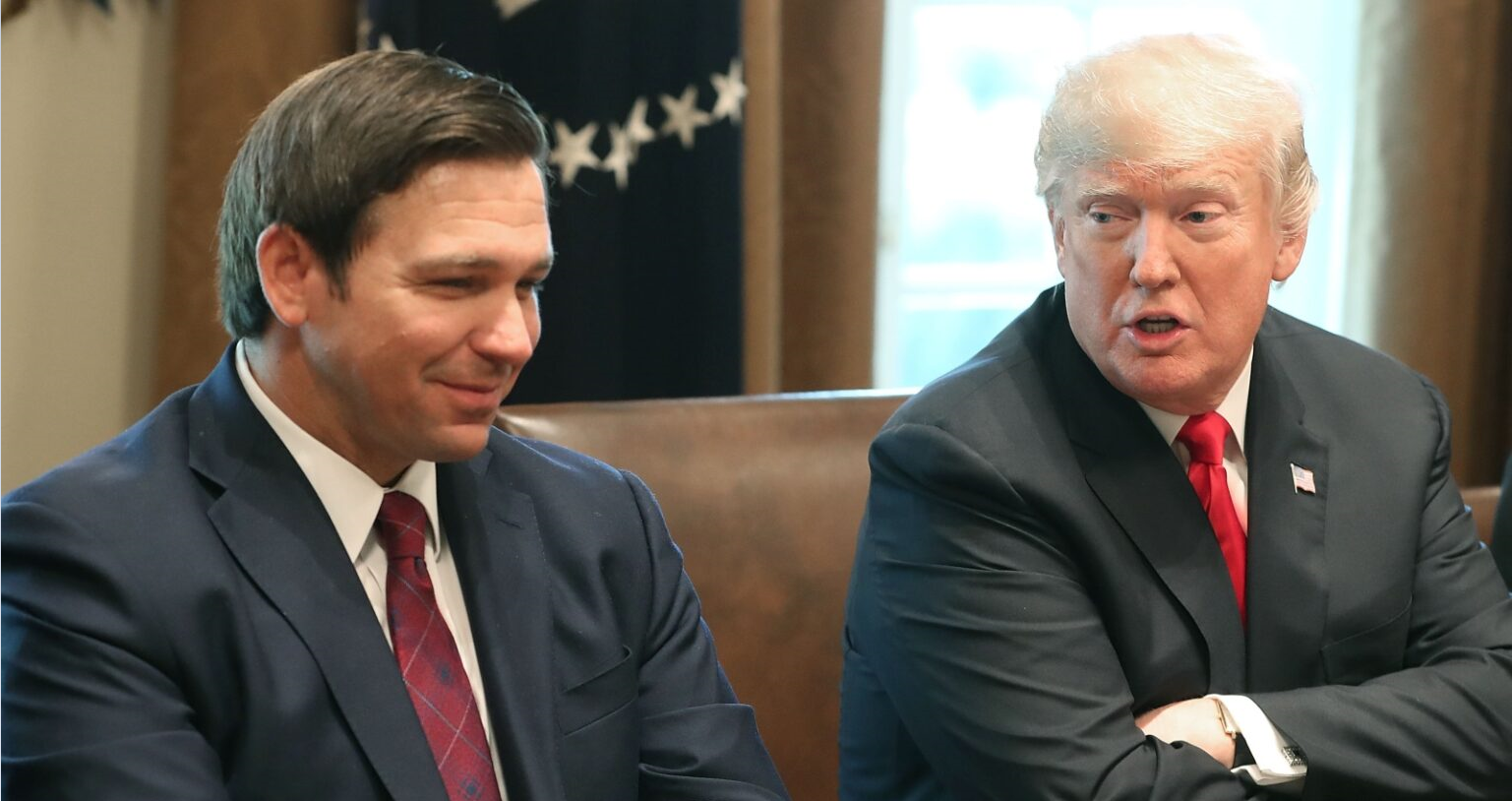
Several interconnected political developments involving Donald Trump and Ron DeSantis, highlighting both their evolving relationship and broader policy and legal shifts affecting U.S. politics.
President Trump stated that he is considering appointing DeSantis to a future cabinet position once the Florida governor’s term ends. This reflects a notable shift from their earlier rivalry during the 2024 Republican presidential primary, where DeSantis ran against Trump but ultimately lost momentum after the Iowa caucuses. Since then, DeSantis has endorsed Trump and aligned himself more closely with the administration’s priorities, including immigration enforcement and other policy initiatives.
DeSantis has also publicly supported recent actions by Trump, including an executive move related to college athletics that allows student-athletes to transfer schools once without penalty. This alignment underscores the strengthening political relationship between the two figures after their earlier competition.
At the same time, Florida has become a focal point in the national redistricting debate. State lawmakers, led by DeSantis, moved quickly to approve a new congressional map shortly after a major ruling by the U.S. Supreme Court. The map was passed largely along party lines, with Republicans supporting it and Democrats opposing it. Critics argued the new map violates Florida’s anti-gerrymandering rules approved by voters, while supporters contended that recent legal developments justify the changes.
The redistricting push is tied directly to the Supreme Court’s decision involving Louisiana, where the justices ruled against the use of race as a primary factor in drawing congressional districts. That ruling has broad implications, potentially allowing states to redraw maps without creating majority-minority districts in certain cases. DeSantis had previously indicated that such a ruling would require Florida to revisit its own district lines, which led to the rapid legislative action.
The Florida debate reflects a wider national trend, as several states—including Texas, North Carolina, and Missouri—have pursued mid-decade redistricting. Analysts suggest that these changes could affect the balance of political power in the U.S. House of Representatives.
Overall, the developments illustrate both a political realignment between Trump and DeSantis and a significant shift in election law following the Supreme Court’s ruling. Together, these factors are shaping policy decisions and electoral strategies at both the state and national levels.