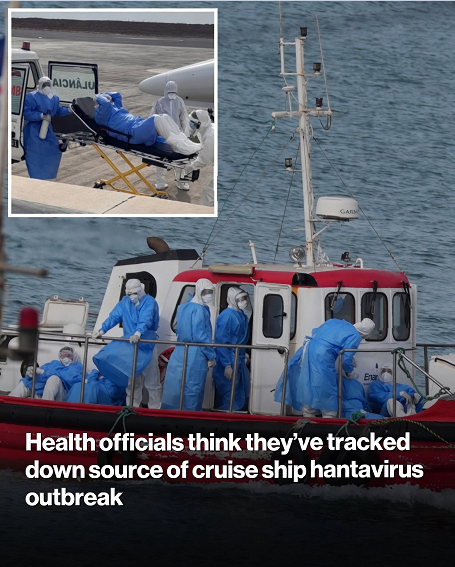
A serious health incident aboard the expedition cruise ship MV Hondius has drawn international attention after multiple passengers were infected with hantavirus, leading to at least three deaths and several medical evacuations.
Investigators believe the outbreak may have originated in Ushuaia, where a Dutch couple—among the first victims—participated in a bird-watching excursion. Officials suspect they were exposed to the virus through contact with rodent-contaminated areas, possibly near a landfill. However, this theory is uncertain, as the surrounding Tierra del Fuego region had no previously recorded hantavirus cases, raising questions about the true source of the infection.
The couple boarded the ship on March 20 for a 35-day voyage. The 70-year-old man began showing symptoms in early April, including fever, abdominal pain, and respiratory distress, and died on April 11. His illness was only later confirmed as hantavirus. His body remained onboard for about two weeks, during which his wife also became ill. She later died in a hospital in Johannesburg after being flown there with her husband’s body.
In the following weeks, eight more passengers and crew reported symptoms, and a third person died onboard. By early May, the situation escalated, prompting evacuations. Three infected individuals—a British, Dutch, and German national—were airlifted from the ship near Praia for treatment in the Netherlands. Some were reported to be in serious condition. The ship’s doctor was also among those infected but has since improved.
Hantavirus is typically transmitted through inhalation of particles from infected rodent urine or droppings and is not commonly spread person-to-person, which has helped limit wider transmission onboard. As of the latest reports, remaining passengers and crew have not shown symptoms.
The ship has remained anchored near Cape Verde, with plans to eventually dock in Tenerife. However, this has sparked concern among local officials, including Canary Islands president Fernando Clavijo, who cited a lack of clear protocols and fears about potential spread.
Health authorities, including the World Health Organization, continue to monitor the situation closely as efforts focus on containment, treatment, and determining the precise origin of the outbreak.