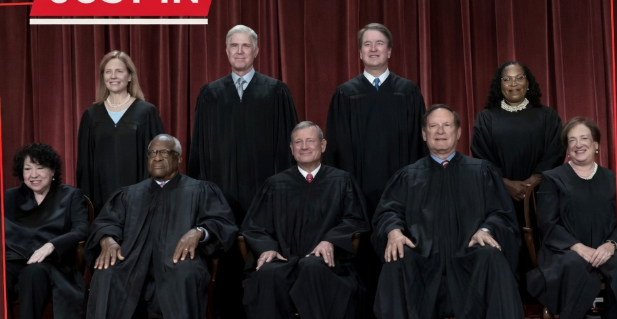
Marsha Blackburn called for an investigation into Ketanji Brown Jackson after the justice attended the Grammy Awards, where some performers made remarks critical of Immigration and Customs Enforcement (ICE). Blackburn argued that Jackson’s attendance at what she described as a “highly politicized” event raised concerns about judicial impartiality and public confidence in the Supreme Court.
Justice Jackson attended the awards ceremony because her memoir, Lovely One, received a nomination in the Best Audio Book, Narration, and Storytelling Recording category. The award ultimately went to Dalai Lama for Meditations: The Reflections of His Holiness the Dalai Lama. However, the controversy centered less on the nomination itself and more on the political statements made during the event.
According to Blackburn, some performers at the ceremony criticized federal immigration enforcement and ICE agents during acceptance speeches and public appearances. Blackburn claimed Jackson was seen applauding during at least one anti-ICE remark, though no official statement from the justice addressed the specific allegations. In response, Blackburn sent a letter to John Roberts requesting a formal investigation into whether Jackson’s attendance violated judicial ethics standards.
Blackburn argued that Supreme Court justices must avoid situations that could create the appearance of political bias, especially regarding issues that may later come before the Court. She cited the judiciary’s ethical obligation to act in ways that preserve public confidence in the integrity and impartiality of the judicial system. Her letter questioned whether attending an event featuring strong anti-law-enforcement messaging could compromise Jackson’s perceived neutrality on immigration-related cases.
The senator also compared the controversy to past ethics debates involving conservative justices. She referenced criticism directed at Clarence Thomas over undisclosed trips funded by businessman Harlan Crow and calls for Samuel Alito to recuse himself from January 6-related cases. Blackburn argued that concerns about Jackson were more substantial because they involved direct participation in what she viewed as an openly political environment.
Conservative commentators amplified Blackburn’s criticism, with some arguing that Jackson’s presence at the Grammys blurred the line between celebrity culture and judicial responsibility. Commentator Alex Marlow criticized the idea of a sitting Supreme Court justice attending an event where anti-law-enforcement rhetoric was publicly celebrated.
At the same time, supporters of Jackson argued that attending a major cultural event tied to her memoir nomination did not necessarily indicate political bias. They noted that public officials, including Supreme Court justices, frequently participate in public and cultural events without compromising their legal responsibilities. Jackson herself has previously acknowledged that public scrutiny comes with serving on the nation’s highest court.
The Supreme Court did not immediately comment on Blackburn’s request for an investigation. The controversy reflects the growing politicization surrounding the judiciary, where public appearances by justices increasingly become part of broader ideological battles between conservatives and liberals.
More broadly, the dispute highlights continuing tensions over judicial ethics, public perception, immigration policy, and the role of cultural events in political discourse. As debates over Supreme Court impartiality continue, both parties have increasingly accused opposing justices of political behavior, contributing to declining public trust in the Court’s neutrality.