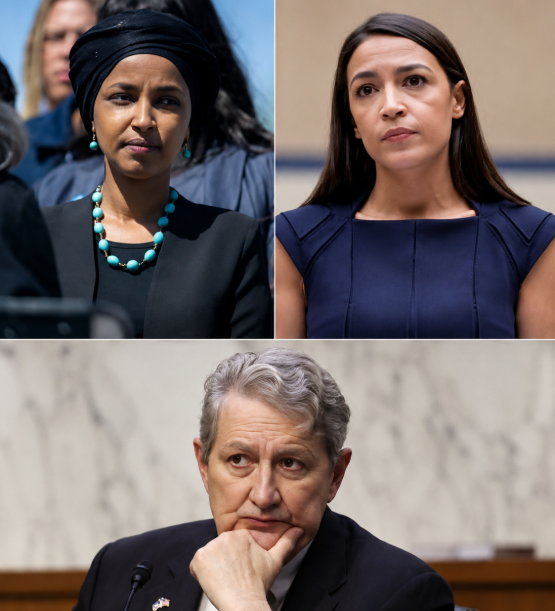
Senator John Kennedy’s recent Senate floor speech, framed around what he called the “Born in America Act,” has become a flashpoint in ongoing debates about loyalty, citizenship, and national identity in U.S. politics. The speech, delivered amid heightened partisan tensions, quickly gained attention after being broadcast on C-SPAN and widely circulated on social media platforms.
In his remarks, John Kennedy criticized what he described as a growing tendency among some lawmakers to prioritize ideological or global concerns over national interests. Holding up a folder labeled the “Born in America Act,” Kennedy used the prop to emphasize his argument that public officials should demonstrate uncompromising allegiance to the United States. He called for increased scrutiny of foreign influence in politics, campaign financing, and potential conflicts of interest among members of Congress.
The speech referenced progressive lawmakers, including allies of Representative Alexandria Ocasio-Cortez, though Kennedy did not present a formal legislative proposal matching the title he used. According to available congressional records, no bill named the “Born in America Act” has been introduced, suggesting the phrase functioned as a rhetorical device rather than a concrete policy initiative.
Reactions to the speech were immediate and sharply divided. Supporters praised Kennedy for taking a forceful stance on patriotism and accountability, arguing that his remarks reflect concerns about national security and the integrity of elected officials. Critics, however, condemned the speech as divisive and potentially harmful, warning that questioning the loyalty of lawmakers—particularly naturalized citizens—could undermine constitutional principles of equality and representation.
Legal scholars and commentators noted that the U.S. Constitution already establishes clear eligibility requirements for public office. While the presidency is reserved for natural-born citizens, naturalized citizens are fully eligible to serve in Congress once they have taken the oath of office. Expulsion from Congress requires a two-thirds vote and is typically reserved for ethical violations or criminal conduct rather than ideological disagreement.
The controversy also sparked broader discussions about immigration, dual loyalties, and foreign influence in American governance. Some Republican voices echoed concerns about external interference, while others cautioned against rhetoric that could alienate immigrant communities or blur the distinction between policy disagreement and accusations of disloyalty.
Democratic lawmakers and advocacy groups described the speech as inflammatory, arguing that it risks eroding trust in democratic institutions at a time of already deep political polarization. Several naturalized members of Congress publicly reaffirmed their commitment to the United States and emphasized their constitutional oath.
More broadly, the episode reflects recurring tensions in American political life, particularly during periods of global uncertainty. Questions about identity, citizenship, and national loyalty often intensify alongside debates over immigration and foreign policy. Analysts note that such moments tend to energize political bases but also deepen partisan divides.
As of now, no formal legislation has emerged from Kennedy’s remarks. However, the viral nature of the speech underscores how symbolic political messaging—amplified by media and social platforms—can shape national conversations even in the absence of actual policy change.