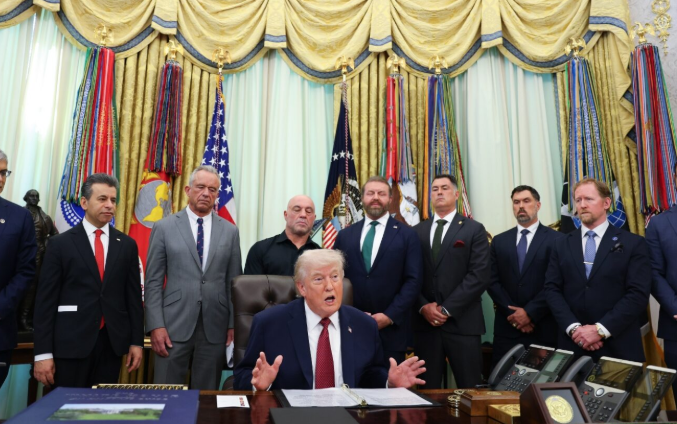
President Donald Trump announced a new executive order aimed at accelerating federal approval and research efforts involving psychedelic-based medical treatments, particularly for military veterans suffering from mental health conditions and traumatic brain injuries. Speaking at the signing ceremony, Trump said the order directs the FDA to speed up the review process for psychedelic substances already designated as “breakthrough therapy” drugs, with the goal of expanding treatment access more quickly.
According to Trump, the initiative is intended to reduce bureaucratic barriers that have slowed research and approval efforts for years. The order reportedly increases coordination between the FDA and the Department of Veterans Affairs while also improving data sharing among federal agencies. Trump said the reforms would help speed the potential rescheduling of psychedelic substances if they receive FDA approval in the future.
The president highlighted the mental health crisis affecting veterans, especially high suicide rates among former service members. He argued that experimental psychedelic therapies have shown promising results for severe depression, anxiety, PTSD, and traumatic brain injuries. Trump specifically referenced ibogaine treatment, citing a 2024 Stanford University study involving special operations veterans. According to the president, participants reportedly experienced major reductions in depression and anxiety symptoms within one month of treatment.
Trump also announced a new $50 million federal investment in ibogaine research, matching a similar commitment previously made by Texas Republican leaders. In addition, he said the administration would create a pathway allowing certain critically ill patients to access ibogaine treatment under existing “Right to Try” laws, which are designed to provide experimental therapies to patients with serious conditions.
The executive order represents one of the most significant federal endorsements of psychedelic-based medical research in recent years. Supporters argue the move could speed innovation in mental health care, especially for veterans who have not responded to traditional treatments. Critics, however, are likely to raise questions about safety, regulation, and the long-term effects of psychedelic substances, emphasizing the need for rigorous clinical testing before widespread approval.
The article also referenced another recent executive order signed by Trump focused on election administration and voter eligibility verification. That directive seeks to expand federal involvement in election oversight by requiring agencies such as the Department of Homeland Security and the Social Security Administration to share citizenship data with state election officials. The order also calls for increased Justice Department enforcement related to election law violations and directs the U.S. Postal Service to develop standardized nationwide procedures for tracking and verifying mail-in ballots.
Together, the two executive orders reflect the administration’s efforts to pursue major policy changes in both healthcare research and federal election procedures, while continuing to generate national debate over the proper role of federal authority in these areas.