Naval confrontation in the Strait of Hormuz involving the U.S. and Iranian forces, framed as a turning point in modern electronic warfare and maritime strategy.
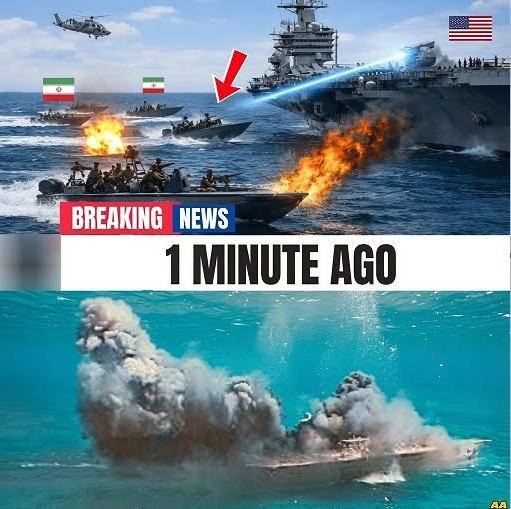
According to the narrative, the situation unfolds as the Strait of Hormuz becomes the setting for a tense encounter between the USS Nimitz and fast attack boats operated by the Islamic Revolutionary Guard Corps.
In the account, eleven Iranian fast attack boats depart from Bandar Abbas with the intention of projecting force and challenging U.S. naval presence in the region. The Strait of Hormuz is emphasized as a critical global chokepoint, with a significant portion of the world’s oil supply passing through it, making any confrontation there strategically significant.
As the vessels approach the U.S. carrier group, the narrative describes an unexpected shift in conditions.
Rather than escalating into a kinetic exchange involving missiles or gunfire, the encounter is portrayed as being decided through electronic warfare. Iranian navigation and communication systems are said to fail abruptly, resulting in the loss of GPS signals and radio functionality across the attacking boats. This disruption allegedly leaves the Iranian craft disoriented and unable to coordinate effectively, forcing the confrontation to end without traditional combat.
The passage presents this outcome as a demonstration of a new era in naval warfare, where technological superiority—particularly in electronic warfare and signal disruption—can neutralize adversary forces without physical destruction. The United States Navy is depicted as leveraging advanced non-kinetic capabilities to achieve strategic advantage while avoiding escalation.
The broader implications emphasized in the text suggest that modern conflict is increasingly defined by control over information systems, communications networks, and electronic infrastructure rather than conventional firepower alone.
This shift is portrayed as reshaping military planning, deterrence strategies, and global security dynamics.
The narrative also highlights the psychological and geopolitical impact of such an encounter. It suggests that Iran’s forces were caught off guard by the electronic disruption, while the United States demonstrated restraint combined with technological dominance. This, in turn, is framed as a message to other global powers about the evolving nature of maritime control.
Finally, the passage concludes that incidents like this—whether fully verified or interpreted through strategic reporting—underscore a broader transformation in warfare. The Strait of Hormuz is presented not only as a physical chokepoint for global energy flows but also as a symbolic arena where future conflicts may increasingly be decided through technology, electronic dominance, and strategic deterrence rather than direct military engagement.