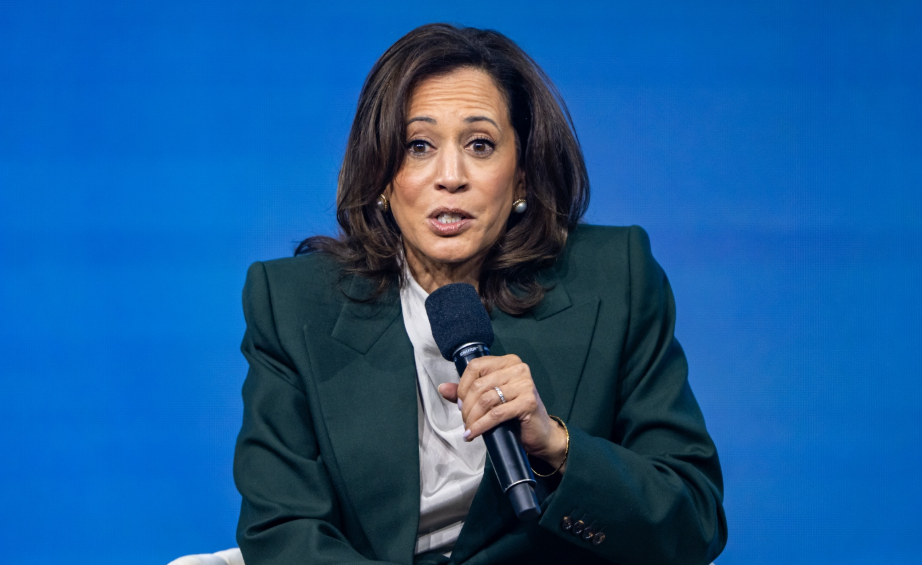
Former Vice President Kamala Harris may be mulling a comeback presidential run in 2028, but more evidence surfaced last week indicating she may want to rethink her plans.
Iowa Democratic gubernatorial nominee Rob Sand made clear in a recent interview that he is ready for his party to move beyond Harris as speculation continues about another potential presidential campaign.
Sand, who has served as Iowa’s state auditor since 2019, has sought to position himself as a moderate Democrat as he attempts to become the first member of his party to win the governor’s mansion since 2010.
He faces Republican businessman Zach Lahn in November’s race to succeed outgoing Republican Gov. Kim Reynolds.
During an interview with Politico’s Jonathan Martin at the Iowa State Fair, Sand was also asked whether he would be interested in having former President Joe Biden campaign alongside him.
“No,” Sand responded. “Can he even do that right now?”
The exchange underscored Sand’s effort to establish his own political identity rather than rely on prominent figures from the Democratic Party’s previous presidential ticket.
His answer was similar when he was asked about the prospect of Harris campaigning with him as well. “No thanks. Let’s move on. We need some new leadership.”
Martin then asked, “You don’t think Harris should run in 2028?” Martin added, to which Sand replied with a definitive “no.”
Martin followed up by asking Sand’s view on the best option for Democrats in 2028, including whether a governor or someone not from Washington, D.C., should be the nominee.
“You got my gut reaction on a couple. I don’t know what the answer to that is,” Sand said.
“I got an election in 75 days. We just had news this week about this cancer vaccine for skin cancer, and my opponent wants to ban vaccines like that,” he added.
“I’m pretty focused on what we’ve got going on right here in Iowa. Those are conversations for down the road,” Sand noted further.
Despite Sand’s opposition to another Harris presidential campaign, national polling suggests the former vice president remains a leading contender for the 2028 Democratic nomination.
Multiple surveys conducted during the summer have shown Harris receiving the largest share of support among potential Democratic candidates, underscoring the continued strength of her national profile nearly two years after her loss to President Donald Trump.
A RealClearPolling average of surveys conducted from early July through late August placed Harris at 24.6%, giving her a sizable advantage over California Gov. Gavin Newsom, who stood at 15.2%.
Other potential contenders trailed further behind, leaving Harris at the top of a still highly unsettled Democratic field.
The early numbers come with an important caveat: the 2028 presidential primaries remain more than two years away, no major Democratic candidate has formally secured the nomination battle, and polling this far in advance can change substantially as the field takes shape.
Harris’ abbreviated 2024 presidential campaign, launched after President Joe Biden withdrew from the race, dramatically elevated her national profile but ended with Donald Trump’s return to the White House.
Nearly two years later, Democrats are still debating Harris’ place in the party’s future as candidates in closely contested races attempt to establish their own political identities and distance themselves from unpopular elements of the national party.
Harris’ memoir, “107 Days,” recounts her abbreviated 2024 presidential campaign and offers glimpses of her frustrations with Biden’s staff, foreign governments and the media during the whirlwind race.
But the book did little to answer one of the biggest questions surrounding the former vice president: what role she intends to play in Democratic politics going forward.