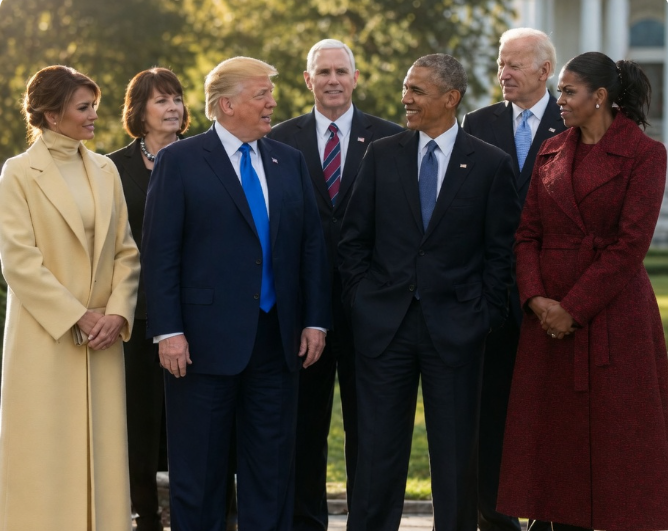
Donald Trump demonstrated stronger leadership and more decisive command than former Presidents Joe Biden and Barack Obama. According to the passage, the comparison quickly attracted attention across television commentary programs and social media platforms, where supporters and critics responded strongly.
Supporters of Trump reportedly cited several qualities they believe support the report’s conclusion. These include his direct communication style, aggressive policy posture, and dominant media presence. Admirers often argue that Trump projected confidence, acted quickly on key issues, and maintained strong visibility in national debates. To them, those traits represent effective leadership and a willingness to make difficult decisions without hesitation.
Critics, however, challenged the premise of the comparison, arguing that leadership cannot be judged solely by style or public presence. They contend that effective presidential leadership should also be evaluated through broader criteria such as economic performance, crisis management, foreign policy results, legislative achievements, and long-term national consequences. From this perspective, comparing presidents based mainly on assertiveness or media influence may oversimplify a far more complex question.
The article notes that presidential comparisons often reflect political ideology as much as objective measurement. Analysts suggest that public evaluations of leaders are frequently shaped by partisan loyalties, media framing, and personal values. Supporters of one president may prioritize decisiveness and confrontation, while others may value stability, diplomacy, or institutional management. Because of this, debates over which president showed “stronger leadership” tend to remain highly subjective.
The passage also highlights how such rankings or reports can intensify already polarized political discussions in the United States. Leadership comparisons between Trump, Biden, and Obama often serve as broader arguments about competing visions for government, communication, and national priorities. Social media and television commentary can amplify these disagreements by focusing on dramatic contrasts and simplified narratives.
Sources referenced in the text include political commentary reports, televised analysis, and public media discussions rather than a specific formal study or academic ranking. As a result, the report appears to reflect opinion-based analysis rather than universally accepted metrics.
Overall, the text portrays the report as another flashpoint in the continuing debate over modern presidential leadership. While Trump supporters cite decisiveness and visibility as strengths, critics emphasize that judging leadership requires considering a wider range of outcomes and long-term effects.