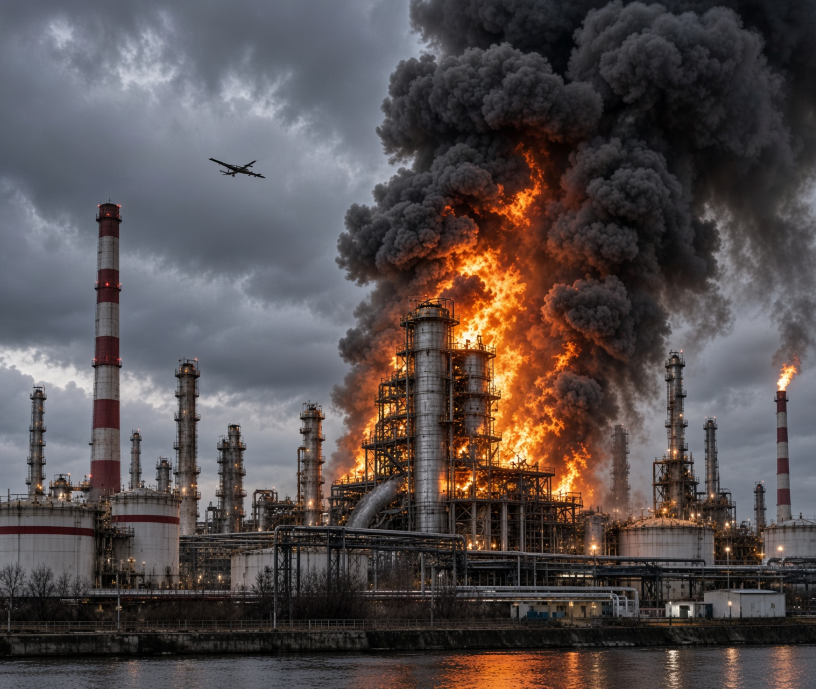
Ukraine Hit One of Russia’s Biggest Refineries — But the Fire Wasn’t the Real Story On September 6, smoke and flames engulfed Rosneft’s massive Ryazan oil refinery—a plant responsible for roughly 5% of Russia’s total crude processing. But the dramatic fire was only surface-level damage.
Four days later, industry data confirmed the real blow: critical primary distillation units (CDU-6 and CDU-4) were forced completely offline while another unit was already undergoing maintenance, paralyzing the refinery’s ability to process crude oil for weeks. Ryazan was just one piece of a synchronized, multi-layered pressure campaign. Over a single two-week stretch, Ukrainian long-range strikes struck the Saratov and Syzran refineries just as they attempted to restart, disrupted the Caspian Sea port of Makhachkala, deployed new domestically built FP-5 Flamingo cruise missiles against industrial facilities near Volgograd, and sent drones over 3,000 kilometers into western Siberia to hit natural gas hubs in Novy Urengoy. In this deep dive, we look past the fireballs and smoke to analyze the true bottleneck of modern industrial warfare: the “repair clock.” We examine how taking down crude distillation columns cascades across fuel supplies, why repeated strikes disrupt repairs before plants can restart, and how targeting processing capacity is forcing domestic fuel shortages and export bans across Russia.