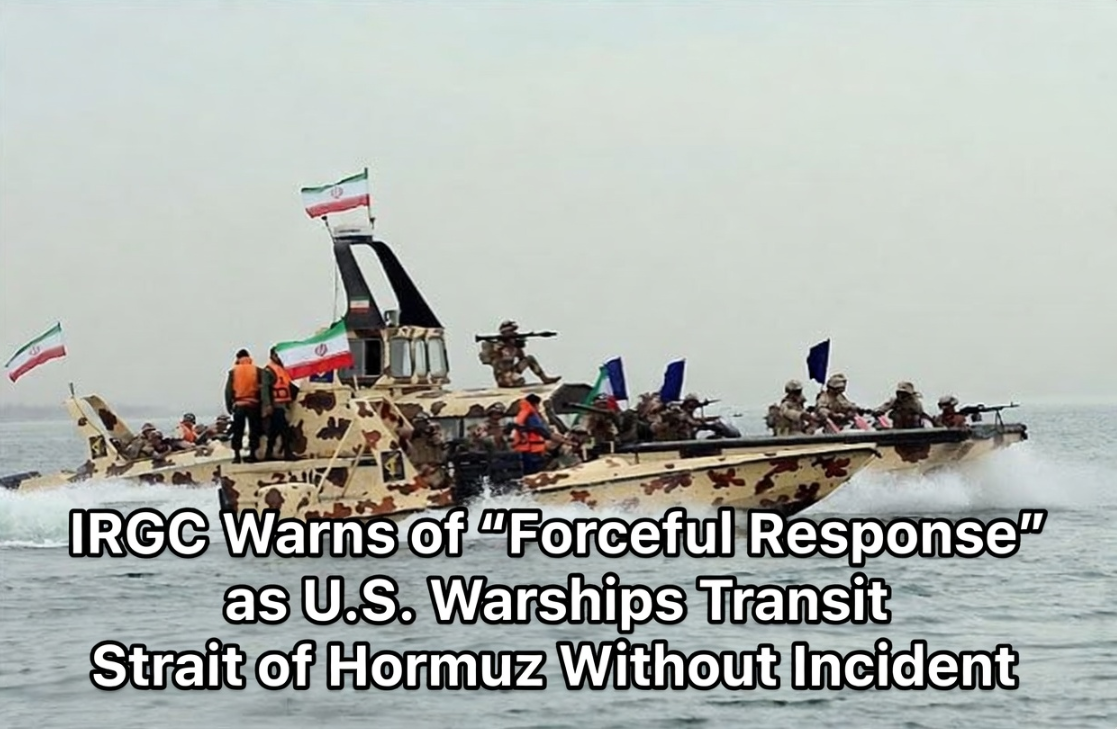
In an official statement broadcast early Sunday through Islamic Republic of Iran Broadcasting, the Islamic Revolutionary Guard Corps Navy issued a warning that any foreign military vessels attempting to transit the Strait of Hormuz would face what it described as a “firm and forceful response.” The IRGC Navy further claimed that it maintains full control over the narrow maritime chokepoint located between Iran and Oman, one of the most strategically significant waterways in global energy transportation.
The statement followed reports that two U.S. Navy guided-missile destroyers—USS Frank E. Peterson (DDG-121) and USS Michael Murphy (DDG-112)—recently transited the Strait of Hormuz as part of a freedom-of-navigation operation. According to U.S. officials cited in reporting, the vessels successfully passed through the strait, entered the Persian Gulf, and later withdrew into the Arabian Sea without encountering any incidents or interference.
The Strait of Hormuz is widely regarded as one of the most important maritime corridors in the world, with a significant portion of global oil shipments passing through its narrow passage. Because of its strategic importance, the waterway has frequently been a focal point of military presence, signaling, and geopolitical tension between regional powers and external naval forces.
The contrasting statements underscore the ongoing friction surrounding maritime rights and security in the region. While U.S. officials characterize such transits as routine freedom-of-navigation operations conducted under international law, Iranian authorities often frame foreign naval presence as a challenge to their sovereignty and regional authority.
Despite the rhetoric, there were no reported confrontations during the most recent transit. The incident instead reflects the continuing pattern of cautious but persistent naval activity by multiple actors in a highly sensitive and closely monitored shipping lane that remains central to global trade and energy security.