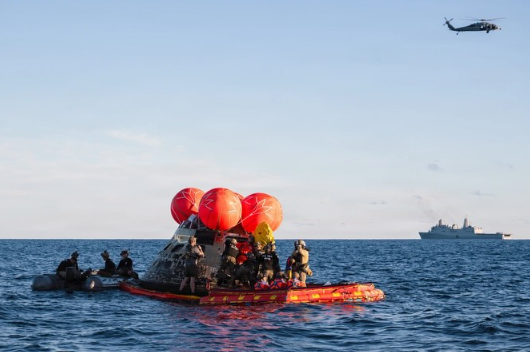
U.S. Navy divers assigned to Explosive Ordnance Disposal Group One (EODGRU-1) carried out a hazardous material detection sweep aboard the USS John P. Murtha (LPD-26) as part of recovery operations for the Artemis II mission. The operation took place in the Pacific Ocean off the coast of San Diego on April 10, 2026, following the splashdown of NASA’s Orion capsule the previous day.
The Navy divers were tasked with ensuring the safety of recovery personnel and the returning astronauts by scanning the spacecraft and surrounding area for any hazardous materials. Such sweeps are a standard and critical precaution in space recovery missions, as they help detect potential risks such as toxic propellants or other contaminants that may be present after reentry and landing. By conducting these inspections before astronaut extraction, the team ensures that both the crew and support personnel are protected from possible exposure.
The USS John P. Murtha served as the primary recovery vessel, providing a mobile platform equipped with the necessary facilities and personnel to support the operation. Once the Orion capsule was deemed safe, recovery teams proceeded with extracting the Artemis II crew, marking a significant milestone in NASA’s ongoing efforts to return humans to deep space exploration.
The Artemis II mission represents a major step forward in human spaceflight, as it is designed to test systems and operations needed for future missions beyond Earth orbit. The successful recovery highlights the coordination between NASA and the U.S. Navy, demonstrating the importance of joint operations in ensuring mission success and crew safety.
Overall, the hazardous material sweep and subsequent recovery efforts underscore the precision, planning, and interagency cooperation required for modern space missions, particularly those involving human crews returning from challenging environments beyond Earth.