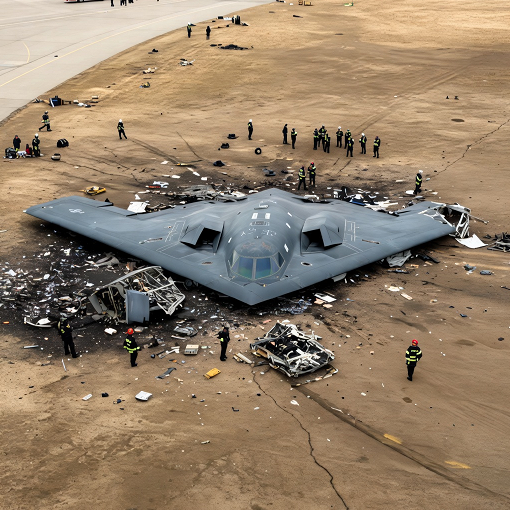
The B-2 Spirit stealth bomber has long been the subject of rumors claiming it was secretly shot down during military operations and that the loss was concealed from the public. These stories frequently appear on social media, online forums, and fringe websites, often presented as hidden truths or classified wartime incidents. However, despite decades of speculation, no credible evidence has ever shown that a B-2 has been destroyed by enemy fire. Every verified loss or major incident involving the aircraft has been thoroughly investigated and attributed to accidents or technical failures rather than combat.
The B-2 Spirit is one of the most advanced military aircraft ever built. Developed during the Cold War, it was specifically designed to penetrate heavily defended airspace and evade sophisticated radar systems. Its combination of stealth technology, electronic warfare capabilities, and strategic mission planning has made it one of the most survivable aircraft in military aviation. Because of its unique design and secretive nature, the bomber has become a frequent target of conspiracy theories and misinformation.
The only confirmed total loss of a B-2 occurred on February 23, 2008, at Andersen Air Force Base in Guam. Shortly after takeoff, the aircraft crashed near the runway. Both pilots successfully ejected and survived. The crash attracted worldwide attention because it was the first complete loss of a B-2 since the aircraft entered service. A detailed U.S. Air Force investigation determined that the accident was caused by moisture contamination in the aircraft’s air data sensors. These sensors provided inaccurate information to the flight control computers, causing the bomber to rotate too early during takeoff, stall, and crash. The aircraft, valued at approximately $1.4 billion, was destroyed. Investigators found no evidence of sabotage, hostile action, or external interference.
A second notable incident occurred on September 14, 2021, at Whiteman Air Force Base in Missouri, where the B-2 fleet is based. During landing, a bomber sustained significant damage and was removed from service pending investigation. Although details were limited because of security concerns, military officials confirmed that the event was unrelated to combat and involved no enemy engagement. As with the 2008 crash, speculation quickly spread online, but no credible evidence supported claims that the aircraft had been attacked.
Despite these documented explanations, rumors about secret B-2 shootdowns continue to circulate. Many of these claims reference conflicts such as the NATO air campaign over Serbia in 1999 or suggest encounters with advanced foreign air defense systems. However, such allegations typically rely on anonymous sources, unsupported anecdotes, misinterpreted radar reports, or recycled internet stories. No declassified documents, satellite imagery, pilot testimony, intelligence assessments, or allied military reports have ever confirmed a combat loss of a B-2. Given the aircraft’s strategic importance, experts argue that concealing such a loss indefinitely would be virtually impossible.
The persistence of these rumors is partly driven by the B-2’s reputation as one of the most secretive aircraft ever developed. Its flying-wing design minimizes radar reflections by eliminating vertical surfaces that would normally return strong radar signals. Special radar-absorbing materials further reduce its visibility by absorbing electromagnetic energy rather than reflecting it. As a result, the aircraft presents an exceptionally small radar signature, making detection and tracking extremely difficult.
The bomber’s survivability is also enhanced by measures designed to reduce infrared visibility. Its engines are buried deep within the wing structure, and exhaust gases are cooled and dispersed before leaving the aircraft. This reduces heat signatures that infrared-guided missiles use to locate targets. Combined with high-altitude flight operations, these features make interception significantly more challenging.
In addition to stealth characteristics, the B-2 employs sophisticated electronic warfare systems. Although many details remain classified, these systems are designed to disrupt, confuse, or jam enemy radar and targeting networks. Missions are carefully planned using satellite intelligence, threat analysis, and optimized flight routes to avoid known air defense systems. Rather than relying solely on speed or firepower, the aircraft’s strategy centers on remaining undetected.
Its operational history reinforces this reputation. The B-2 has participated in military campaigns in Kosovo, Iraq, Afghanistan, and Libya, striking heavily defended targets without suffering a combat loss. Confusion sometimes arises because a stealth aircraft was shot down over Serbia in 1999, but that aircraft was an F-117 Nighthawk, not a B-2. The F-117 used older stealth technology and flew more predictable routes, making it vulnerable under specific circumstances.
With fewer than two dozen B-2s ever produced, each aircraft is strategically valuable. Any confirmed shootdown would trigger major military, political, and diplomatic consequences. The absence of evidence supporting such an event strongly undermines claims that one was secretly lost in combat.
Ultimately, the historical record is clear. While the B-2 Spirit has experienced rare accidents and costly losses, every verified incident has been publicly investigated and linked to non-combat causes. Claims that the aircraft was shot down remain unsupported rumors fueled by secrecy, speculation, and the enduring fascination surrounding one of the world’s most advanced stealth bombers.