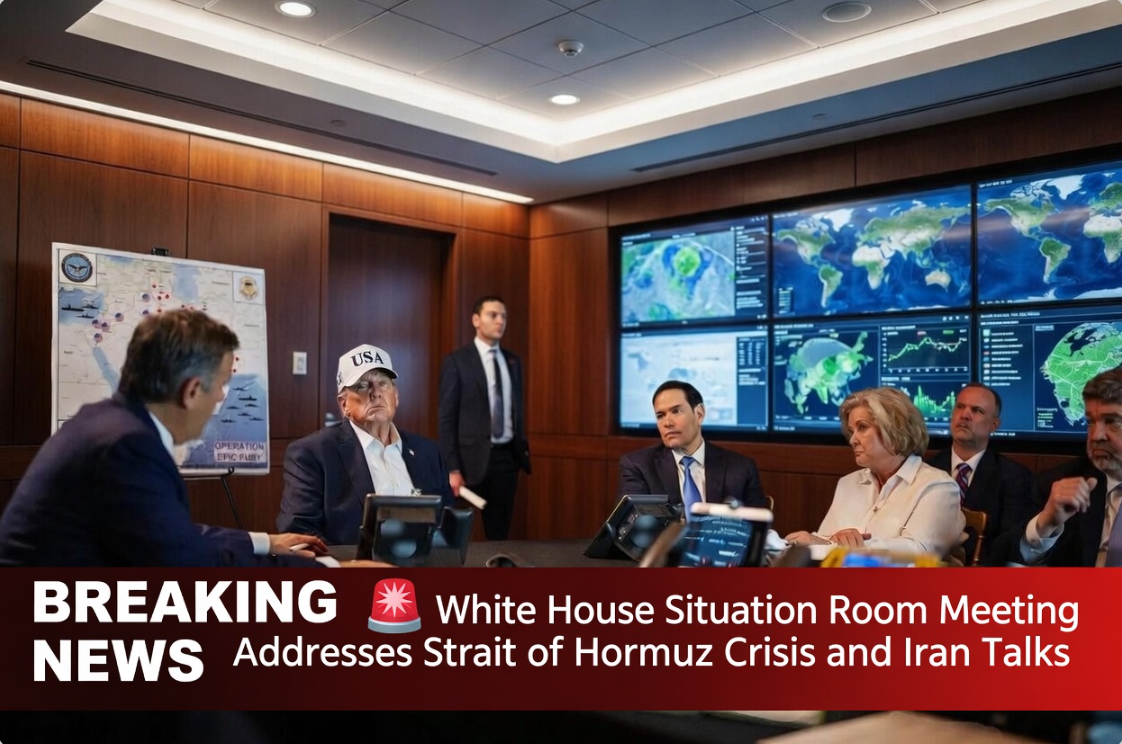
U.S. President Donald Trump convened a high-level national security meeting in the White House Situation Room on Saturday morning to address the escalating crisis surrounding the Strait of Hormuz and ongoing diplomatic efforts with Iran. The meeting, reported by Axios, brought together key members of the administration and senior military and intelligence leadership, reflecting the seriousness of the situation.
Among those in attendance were Vice President JD Vance, Secretary of State Marco Rubio, Defense Secretary Pete Hegseth, and Treasury Secretary Scott Bessent. Also present were Special Envoy Steve Witkoff, CIA Director John Ratcliffe, and Chairman of the Joint Chiefs of Staff Dan Caine. The wide range of officials highlights a coordinated, whole-of-government approach involving diplomacy, defense, intelligence, and economic policy.
The discussions focused on the rapidly evolving situation in the Persian Gulf, where tensions have intensified due to disputes over maritime access, naval blockades, and the uncertain future of a temporary ceasefire. The Strait of Hormuz remains a critical global energy route, with a substantial portion of the world’s oil supply passing through it daily. Any disruption to traffic in this narrow waterway carries significant risks for global markets and international stability.
Officials reportedly examined both immediate and long-term strategies, including military readiness, enforcement of maritime security measures, and ongoing diplomatic negotiations aimed at preventing further escalation. The presence of Treasury leadership also suggests consideration of economic tools such as sanctions and financial pressure.
The Situation Room setting underscores the urgency and sensitivity of the discussions, as it is typically reserved for high-stakes national security decision-making. The meeting reflects growing concern within the administration that the situation could deteriorate quickly if diplomatic efforts fail or if tensions escalate further at sea.
Overall, the gathering signals that the United States is closely monitoring developments and preparing coordinated responses across multiple domains, while continuing to pursue negotiations with Iran to stabilize the region and avoid a broader conflict.