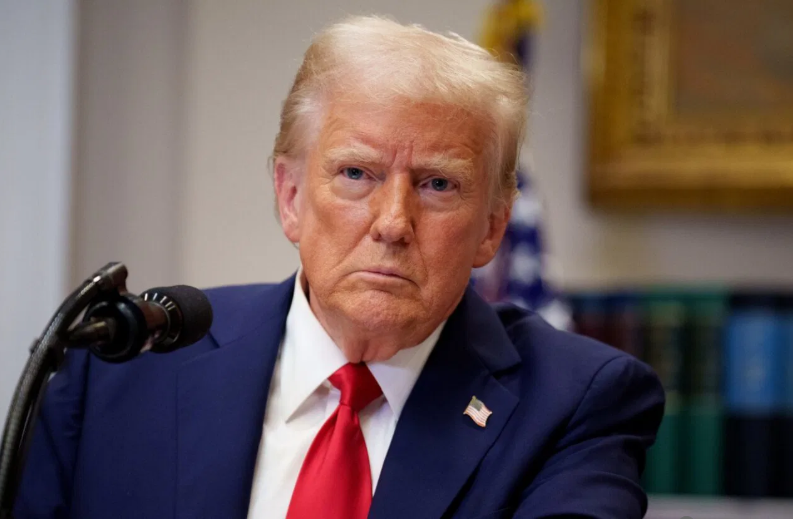
Combines two separate political stories involving Donald Trump and the broader state of U.S. party politics. The first focuses on renewed public attention after cameras captured what appeared to be a bruise or discoloration on Trump’s right hand while he was speaking with reporters before a planned trip to Pittsburgh for an economic summit. The mark was visible when Trump answered questions regarding the ongoing conflict in Ukraine. Although the bruise generated online speculation, Trump continued his schedule without comment, suggesting it was not affecting his daily activities.
The White House has previously addressed similar observations. Press Secretary Karoline Leavitt stated that marks on Trump’s hands were caused by frequent handshakes, describing him as someone who meets and greets large numbers of Americans regularly. Trump himself reportedly told Time that bruising had become common because he shakes hands with thousands of people. The article adds that age can make bruising more frequent, noting that older adults often experience thinner skin, weaker blood vessels, and reduced elasticity, which can make minor impacts more visible. Medical sources such as the Mayo Clinic explain that medications like blood thinners or corticosteroids may also contribute.
The second half of the article shifts to polling data showing dissatisfaction among Democratic voters with their party’s congressional leadership. According to a survey conducted by Quinnipiac University, 53 percent of Democrats disapproved of how Democratic lawmakers in Congress were performing, while 41 percent approved. Among all registered voters surveyed, only 21 percent approved of congressional Democrats, while 70 percent disapproved. The article notes that this ties the lowest approval rating since Quinnipiac began asking the question in 2009.
By contrast, Republican voters were reported to be far more supportive of their own congressional party leadership, with 79 percent approving and only 13 percent disapproving. However, among the overall electorate, congressional Republicans also faced more mixed ratings, with 32 percent approval and more than 60 percent disapproval.
The text concludes by describing the Democratic Party as struggling since recent elections in which Republicans regained the White House and Senate while maintaining control of the House. It argues that Democratic activists increasingly want stronger opposition to Trump’s agenda, contributing to internal frustration and declining favorability ratings.